Most Syndigo implementations push content to Amazon and stop. Autopilot closes the loop — continuously optimizing Amazon listings using Search Query Performance data, Rufus AI discovery signals, and compliance monitoring, then writing optimized content back to Syndigo to syndicate across the largest commerce network in the industry.
Most brands use their PIM the same way: load product content into Syndigo, syndicate it to Amazon and a dozen other channels, and move on. The content sits there. Maybe someone updates it quarterly. Maybe during a relaunch. Not because the PIM can't do more — Syndigo's integrated platform supports continuous updates, AI-powered enrichment, and the most extensive direct retailer network in the industry. But operationally, most teams treat the PIM as a warehouse: a place where content lives, not where it evolves.
That's a problem, because the most valuable optimization signals in ecommerce are generated on Amazon — and in most Syndigo-to-Amazon implementations, they never make it back.
Syndigo is excellent at what it does — and what it does is foundational. It centralizes product information, manages digital assets, enforces compliance with retailer-specific standards, and syndicates content across what is arguably the most extensive direct commerce network available. After its acquisition of 1WorldSync, Syndigo serves 18,000+ enterprises worldwide and maintains direct syndication connections to virtually every major retailer — Amazon, Walmart, Target, Kroger, Home Depot, Lowe's, and hundreds more. Syndigo also provides GDSN data pool connectivity, Enhanced Content distribution, and PowerReviews integration — all from a single platform. For marketplaces beyond Syndigo's direct network, feed management partners extend the reach further. That integrated infrastructure is what makes Syndigo the system of record for product content management, and it should stay that way.
But across the industry — regardless of which PIM a brand runs — syndication is a push operation. Content goes out. Performance data stays on the platform. The Amazon listing accumulates rich signals — which keywords drive clicks, which search queries convert, what shoppers actually type into Rufus, how the category is shifting week over week — and those insights rarely flow back into the PIM to improve the next round of content. It's not a Syndigo limitation; it's an industry-wide gap between content management and content optimization.
Autopilot closes that loop. We read from Syndigo, perform continuous Amazon listing optimization using first-party performance data, and write the results back to Syndigo — keeping it current and making every downstream syndication endpoint smarter.
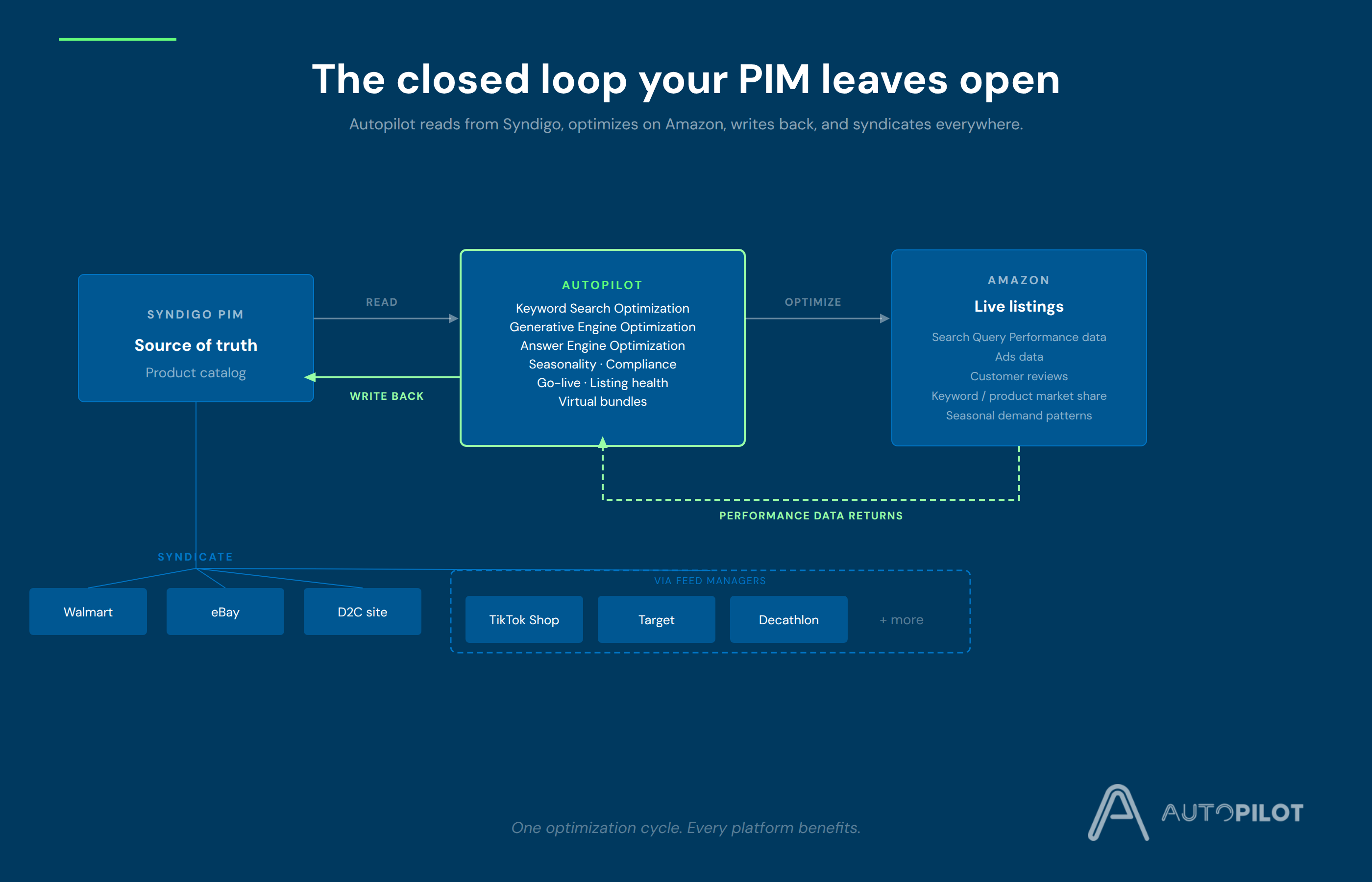
The optimization layer is continuous, not campaign-based. Here's what runs:
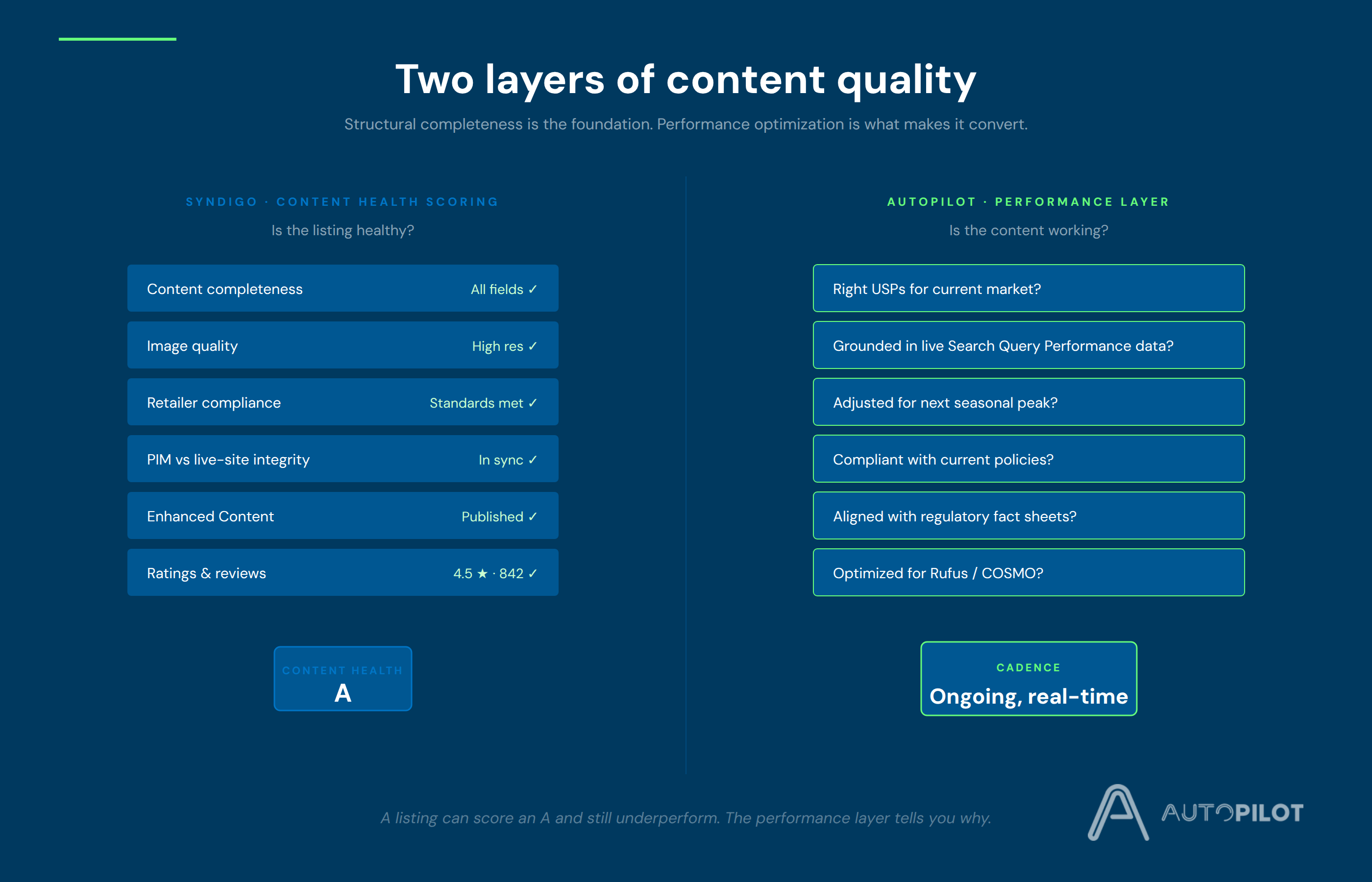
Keyword Search Optimization. We monitor Search Query Performance data weekly, identify the unbranded queries driving impression and purchase share, and weave high-performing search terms into titles, bullets, backend keywords, and A+ content. This isn't a one-time keyword dump. It's ongoing — terms shift seasonally, competitors enter and exit, and Amazon's algorithm reweights relevance signals constantly.
Rufus and AI discovery optimization. Amazon's AI shopping assistant runs on a different logic than traditional keyword search. Rufus is powered by COSMO, Amazon's knowledge graph, which matches products to conversational context — not keyword strings. We structure listing content to address the five COSMO dimensions: subjective properties, event relevance, activity suitability, purpose, and target audience. Backend attributes, Q&A content, and bullet structure all get engineered for how an LLM reads a listing, not just how a human skims it. This is generative engine optimization (GEO) and answer engine optimization (AEO) applied to the commerce surface where 300 million shoppers used AI last year.
Seasonality. Product content shouldn't be static across the calendar. A sunscreen listing in June should emphasize different attributes than the same listing in December, when it's being purchased as a travel or gift item. We adjust content on seasonal cadences — titles, images, A+ modules, and keyword emphasis — timed to when category demand actually spikes, using SQP's absolute market-size data to identify the windows.
Compliance. Amazon's content requirements change without notice — sometimes multiple times per week. Restricted keywords, category-specific attribute requirements, image policy updates, claims validation. We monitor for compliance violations continuously and fix them before they suppress a listing.
Go-live verification. Submitting a content update to Amazon doesn't mean it went live. Updates get stuck, partially applied, rejected silently, or overwritten by Amazon's catalog systems. We run go-live checks on every update, verify the listing reflects what was submitted, and chase resolution with Amazon when it doesn't. This is unglamorous, essential work that most brands discover they need only after losing weeks of traffic to a silently broken listing.
Listing health monitoring. Suppressed listings, hijacked Buy Boxes, broken variations, stranded inventory, indexing failures — any of these can zero out a product overnight. Autopilot monitors listing health in real time and acts on issues immediately, not when someone notices the sales dip two weeks later.
Virtual bundle identification and optimization. Amazon's Virtual Bundles program lets brand-registered sellers combine multiple ASINs into a single bundled listing — no physical repackaging required. Autopilot identifies bundle opportunities from catalog data, search behavior, and frequently-bought-together patterns, creates the virtual bundle listings, and optimizes their content for the keyword combinations that individual products can't rank for on their own. A "camping cookware set" bundle captures search demand that neither the pot, the pan, nor the utensil set would reach individually. Virtual bundles generate incremental revenue from the existing catalog and open new keyword markets without new inventory.
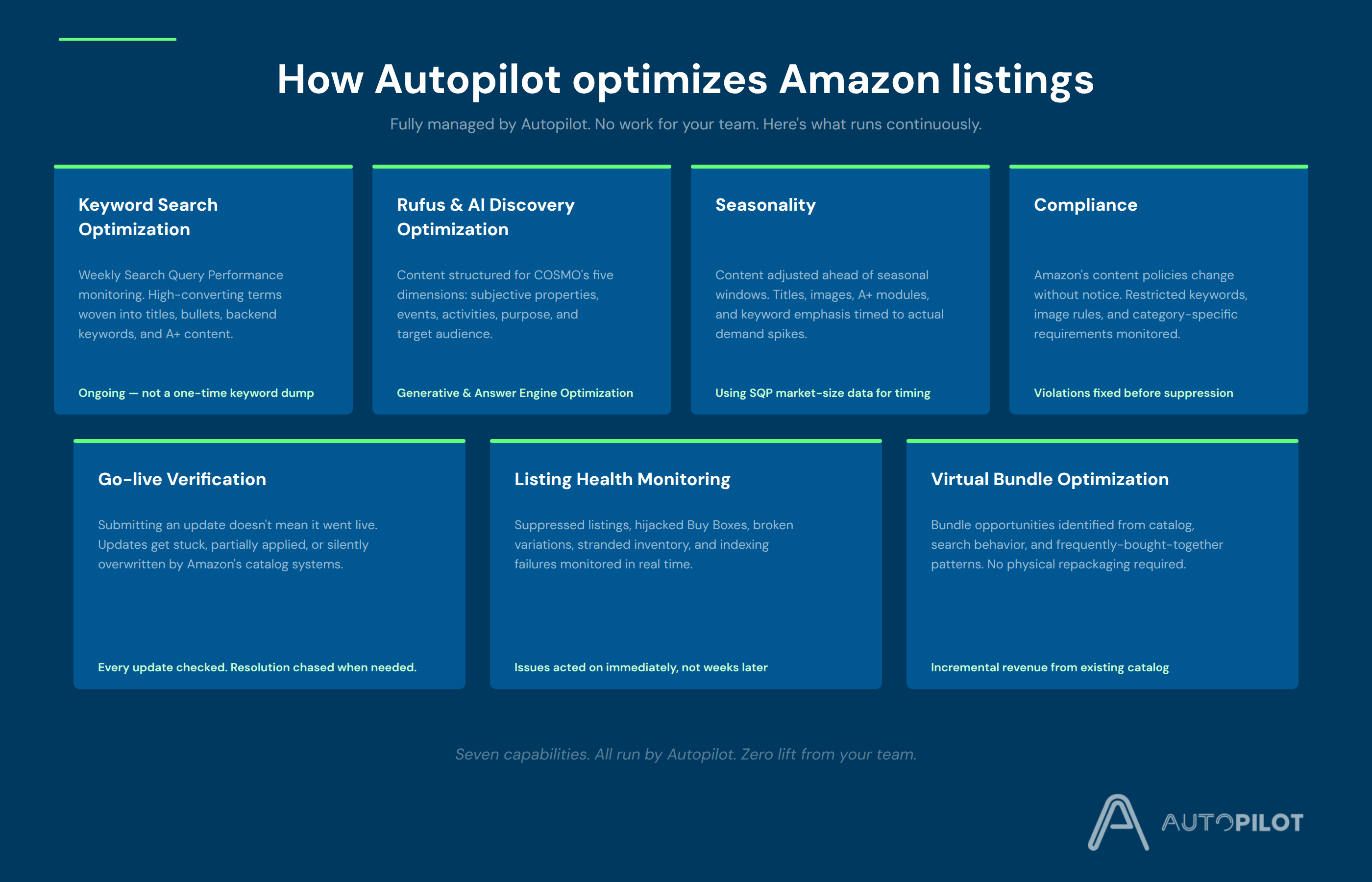
Syndigo already brings strong content analysis tools to the digital shelf. The Content Health Report evaluates quality and depth of product content — including image quality, content completeness, and compliance with retailer standards — with an easy-to-read score that serves as an overall indicator of content health. The Content Integrity Report goes further, comparing PIM data against live site content across retail channels and flagging discrepancies in real time with a visual "Compare with Live" feature. And Syndigo's Digital Shelf Analytics monitors pricing, availability, content health, and ratings across the digital shelf.
These content health tools matter. They're the foundation — making sure every listing is complete, compliant with retailer requirements, and consistent with what's in the PIM. Syndigo does this well, and brands should use it.
But there's a distinction between content health and content performance. Syndigo's tools evaluate whether the content is complete, consistent, and compliant — they do not evaluate whether the content is optimized for how shoppers actually search and buy on Amazon. A listing can score perfectly on content health and still underperform — because the scoring doesn't evaluate whether the right keywords are in the title, whether the messaging matches current shopper intent, or whether the content is structured for how Rufus parses listings.
Autopilot adds a second layer on top: performance-driven content quality on the marketplace itself. Not whether the content is healthy, but whether it's working in the current competitive landscape. These are the questions Autopilot evaluates continuously:
Is it addressing the right USPs? A product's selling points shift based on what's converting in the category, what competitors are emphasizing, and what shoppers are clicking on. SQP data reveals which search queries drive purchase share; the listing content should speak directly to the intent behind those queries.
Is it grounded in live shopper intent? Autopilot maps content directly to Search Query Performance data — the keywords in your title, bullets, and backend are the terms where your brand has measurable share and room to grow, updated weekly as the competitive landscape moves.
Is it adjusted for the next seasonal peak? A listing scored in March doesn't know that the category is about to spike for summer. Autopilot adjusts content ahead of seasonal windows — rotating emphasis, updating imagery cues, and shifting keyword priority — timed to when SQP shows category demand actually moves.
Does it comply with Amazon's evolving content policies? Amazon's content rules change without announcement — restricted claims, prohibited terms, image requirements, category-specific rules. Syndigo's Content Integrity Report validates that the PIM and live site are in sync. Autopilot adds the content-policy layer — monitoring for newly restricted terms and fixing violations before they suppress a listing.
Is the content grounded in regulatory fact sheets? For categories like supplements, beauty, health, and food, product claims must align with what's on the physical label and approved regulatory documentation. Autopilot cross-references listing content against the brand's approved claims and regulatory filings.
Syndigo's content health scoring ensures the listing is complete and compliant. Autopilot's performance layer ensures it's optimized for how shoppers actually search and how AI systems actually parse. Together, they cover the full spectrum — from content health to marketplace effectiveness.
Here's where the architecture gets interesting — and where Syndigo's unmatched syndication network becomes the multiplier.
Every optimization Autopilot makes on Amazon — every keyword adjustment, every content rewrite, every seasonal rotation, every compliance fix — gets written back to Syndigo.
This does three things:
First, it keeps the source of truth current. Product content drifts. Listings get updated on Amazon for performance or compliance reasons, and those changes need to flow back to the PIM — otherwise the central record gradually diverges from what's live. The write-back ensures Syndigo always reflects the latest optimized content, including the data and rationale behind each change. Syndigo's Content Integrity Report then validates that the PIM and live listings stay in sync — a feedback loop that didn't exist before.
Second, it turns Amazon insights into multi-platform content — through the largest commerce network in the industry. This is the strategic payoff, and it's where Syndigo's network scale matters most. Amazon is the single largest source of structured shopper-intent data in ecommerce. When we identify that "insulated bottle for 8-hour shift" converts at 3× the rate of "stainless steel water bottle" on Amazon, that insight doesn't just improve one Amazon listing. Written back to Syndigo, it flows through direct connections to Walmart, Target, Kroger, Home Depot, and hundreds of other retailers. One optimization cycle. Every platform benefits — powered by the most extensive distribution network in the industry.
Third, it future-proofs for GEO and AEO across platforms. Amazon isn't the only platform deploying AI-driven product discovery. Walmart has its own search AI. TikTok Shop surfaces products through recommendation algorithms. Google Shopping runs on LLM-powered product understanding. The content patterns that work for Rufus — structured attributes, conversational context, clear use-case framing — are the same patterns these systems reward. By optimizing for the most advanced AI commerce surface first, and syndicating through Syndigo to everything else, brands get ahead of the GEO/AEO curve on every platform simultaneously.
For brands already running Syndigo, the integration works within the platform's existing architecture — no migration, no parallel systems:
Read. Autopilot connects to Syndigo via API, pulling the current product catalog — titles, bullets, descriptions, backend keywords, images, A+ content references, and attribute data. This is the starting baseline. Syndigo remains the system of record throughout.
Optimize. Autopilot performs the full optimization cycle on Amazon: keyword search optimization, Rufus/GEO structuring, seasonal adjustments, compliance checks, go-live verification, and listing health monitoring. Every change is logged with rationale.
Write back. Optimized content is pushed back to Syndigo through the API, updating the relevant attributes on each product record. Change logs are attached so the brand's content team can see what changed and why — not just the delta, but the data behind the decision. The brand's existing Syndigo workflows, approval rules, and permissions stay intact.
Syndicate. Syndigo's native syndication engine pushes the updated content to its extensive direct retailer network — Walmart, Target, Kroger, Home Depot, and hundreds more. For marketplaces beyond Syndigo's direct connections, feed management partners extend the reach. Channel-specific attribute mappings, compliance rules, and GDSN standards all function as designed. Autopilot doesn't replace any of that infrastructure — it feeds it continuously improving content.
The result: a brand's existing Syndigo investment becomes more valuable. The same syndication network, the same governance model, the same team workflows — now powered by content that's optimized weekly against live Amazon performance data instead of refreshed quarterly against internal assumptions.
A fair question: why optimize on Amazon specifically and syndicate outward? Why not optimize on each platform independently?
Three reasons.
Data density. Amazon has more structured shopper-intent data than any other ecommerce platform. Search Query Performance, Brand Analytics, advertising reports, Rufus prompt data, product opportunity explorer — the signal set is deeper, more granular, and more real-time than what Walmart, TikTok Shop, or any other marketplace exposes to sellers. Optimizing where the data is richest produces the best content.
AI maturity. With Rufus handling 300 million users and driving $12 billion in incremental annualized sales, Amazon is the most advanced AI commerce surface in production. Content that is structured for COSMO's knowledge graph and validated against Rufus's actual recommendations is content that's built for how product discovery works now — not how it worked three years ago. Other platforms are moving in the same direction; Amazon is further along the curve.
Scale economics. Running a full optimization cycle — keyword research, content engineering, go-live verification, compliance monitoring, performance tracking — costs roughly the same whether you do it for one platform or five. But the insights from Amazon are transferable; the insights from smaller platforms mostly aren't. Optimizing Amazon first and syndicating through Syndigo's network to everything else gives you one optimization cost with multi-platform returns — and with Syndigo's direct connections to virtually every major retailer, the ROI on every optimization cycle is maximized.
A brand running this model sees a different operational rhythm than the traditional PIM-to-marketplace flow:
Weekly, not quarterly. Content updates flow based on performance data, not content calendars. When SQP signals that a new search term is gaining share or a seasonal shift is starting, content moves — not when someone remembers to schedule a refresh.
Performance-driven, not assumption-driven. Every content change ties to a measurable signal: a keyword gaining volume, a funnel stage leaking share, a compliance requirement changing, a Rufus recommendation shifting. The brand's content team sees the data behind each update in Syndigo — and Syndigo's Digital Shelf Analytics can track the downstream impact.
Multi-platform by default. Because every Amazon optimization writes back to Syndigo and distributes outward through the largest direct retailer network in the industry, every connected platform benefits from the same intelligence. Syndigo's syndication network amplifies every optimization automatically.
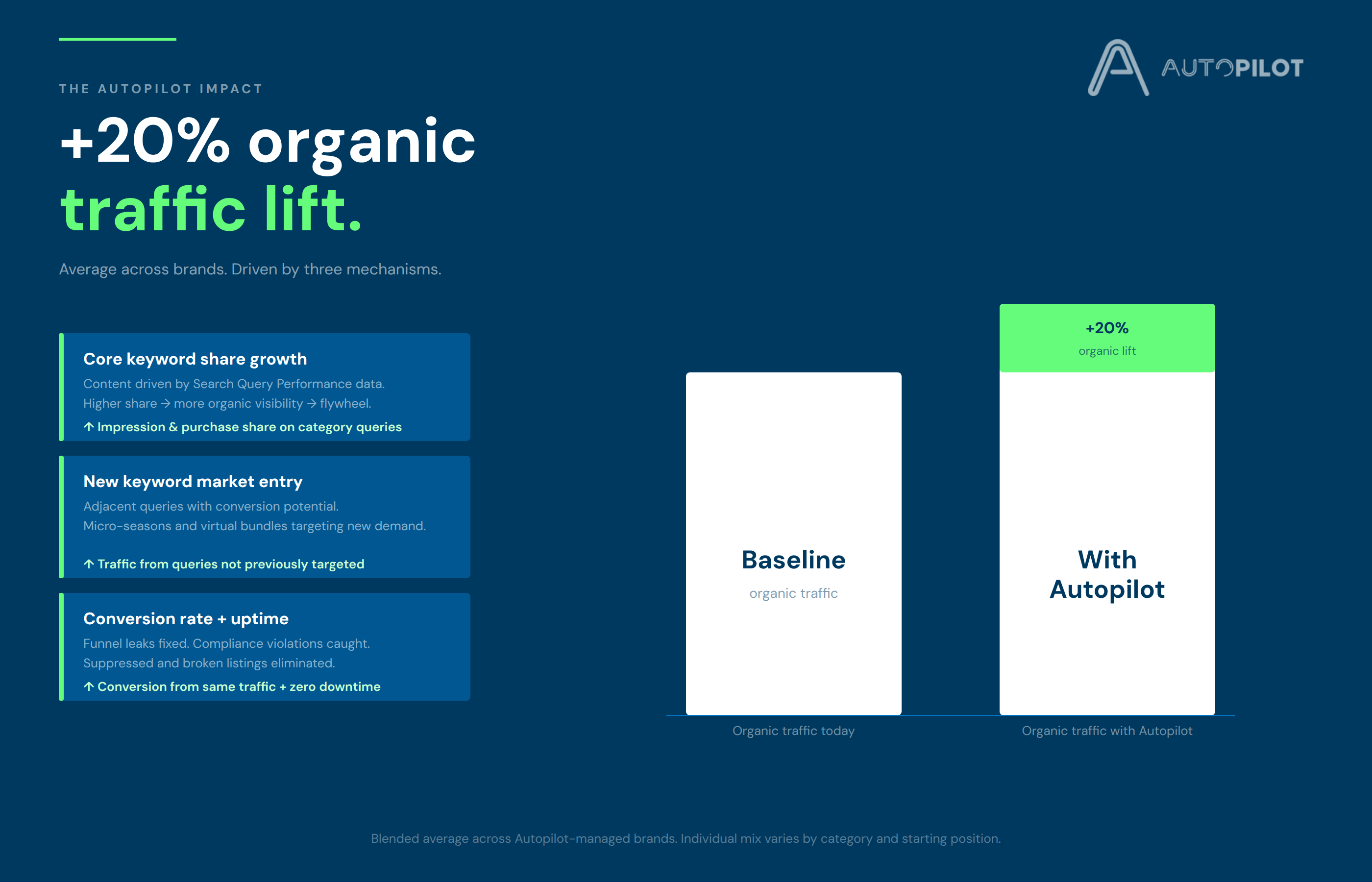
Across the brands Autopilot manages, the continuous optimization loop delivers an average 20% lift in organic traffic — driven by three distinct mechanisms working together.
Growing share on core keywords. The SQP-driven optimization cycle pushes impression and purchase share upward on the unbranded queries that define a brand's category. Higher share means more organic visibility, which compounds — Amazon's algorithm rewards products that convert well with better organic placement, which drives more traffic, which drives more conversion. The flywheel accelerates when content is continuously aligned with what shoppers are actually searching for.
Opening new keyword markets. Most listings are optimized once for a fixed set of terms. Autopilot continuously identifies adjacent and emerging queries where the brand has conversion potential but low or zero impression share — and builds content to establish the product there. This includes micro-seasons (short-lived demand spikes around events, trends, or cultural moments) and virtual bundles (new composite listings that target keyword combinations individual products can't reach). Brands that don't monitor SQP for these windows miss them entirely. Brands running Autopilot enter them early, capture share during the spike, and retain residual organic rank afterward.
Conversion rate and uptime improvements. The funnel diagnostics — identifying and fixing leaks between impression, click, cart-add, and purchase share — directly lift conversion rates by ensuring the right content is in the right place at the right funnel stage. Simultaneously, continuous compliance monitoring and go-live verification reduce listing downtime. A suppressed listing earns zero. A listing that's live but silently broken converts at a fraction of its potential. Eliminating both failure modes compounds with the traffic gains from share growth and new keyword entry.
The 20% organic lift is a blended average across these three vectors. For individual brands, the mix varies — a brand with strong core-keyword share but no seasonal content strategy sees most of its lift from new keyword markets; a brand with frequent compliance issues sees the biggest gains from uptime improvements. The diagnostic framework identifies which lever matters most for each product.
Syndigo gives brands the most integrated infrastructure to manage, distribute, and analyze product content at scale. Autopilot gives that content the intelligence to perform — grounding it in live shopper data, optimizing it for AI-driven discovery, and keeping it current as markets move.
Together, they close the loop between content management and content performance. Amazon generates the insights. Autopilot acts on them. Syndigo distributes the results across the largest commerce network in the industry. The source of truth stays true, and every platform a brand sells on gets smarter content.
Your PIM already connects to every platform your brand sells on. The question is whether the content flowing through it is optimized for how shoppers actually discover products today — across search, AI assistants, and recommendation engines — or whether it's still running on whatever someone wrote during the last product launch.
Does Autopilot replace Syndigo?No. Syndigo remains the system of record for product information. Autopilot connects to Syndigo via API, reads the current product catalog, optimizes listing content on Amazon using first-party performance data, and writes the results back to Syndigo. The brand's existing Syndigo workflows, approval rules, permissions, syndication network, and Digital Shelf Analytics all stay in place.
How does Autopilot integrate with Syndigo?Autopilot uses Syndigo's API to read and write product data. The integration follows a four-step loop: read the current catalog from Syndigo, optimize content on Amazon (keyword search optimization, Rufus/GEO optimization, seasonal adjustments, compliance), write updated content back to Syndigo with change logs and rationale, and let Syndigo's native syndication engine distribute the optimized content across its direct retailer network.
What is the difference between Syndigo's Content Health Report and Autopilot's content optimization?Syndigo's Content Health Report evaluates the quality and depth of product content — including image quality, content completeness, and compliance with retailer standards. The Content Integrity Report compares PIM data against live site content to flag discrepancies. Autopilot adds a marketplace performance layer that evaluates whether the content addresses the right shopper intent on Amazon, targets the right keywords based on live Search Query Performance data, adapts to seasonal demand shifts, complies with Amazon's evolving content policies, and aligns with regulatory fact sheets. Syndigo ensures the content is healthy and compliant; Autopilot ensures it performs.
What is Amazon Search Query Performance (SQP) data?SQP is a first-party dataset available to brand-registered sellers through Amazon Brand Analytics. It reports impression share, click share, cart-add share, and purchase share for each search query associated with a brand's ASINs — along with absolute market volume. Autopilot uses SQP data to identify which keywords drive share, where funnel leaks occur, and how category demand is shifting week over week.
What is GEO and AEO in ecommerce?GEO (generative engine optimization) and AEO (answer engine optimization) refer to optimizing product content for AI-powered discovery systems — like Amazon Rufus, Google AI Overviews, and Walmart's search AI — rather than traditional keyword-based search algorithms. This involves structuring content for how large language models parse product information, including conversational context, use-case framing, and structured backend attributes.
How does Amazon Rufus optimization work?Rufus is Amazon's AI shopping assistant, powered by the COSMO knowledge graph. Unlike traditional keyword search, Rufus matches products to conversational context across five dimensions: subjective properties, event relevance, activity suitability, purpose, and target audience. Autopilot structures listing content — titles, bullets, backend attributes, and Q&A — to align with how COSMO indexes and surfaces products in Rufus conversations.
How does Syndigo's syndication network compare to other PIMs?Syndigo operates the largest direct commerce network in the industry. After acquiring 1WorldSync, Syndigo serves 18,000+ enterprises with direct syndication connections to virtually every major retailer — Amazon, Walmart, Target, Kroger, Home Depot, Lowe's, and hundreds more. The platform also provides GDSN data pool connectivity, Enhanced Content distribution, and PowerReviews integration. For marketplaces beyond Syndigo's direct network, feed management partners extend the reach. This means content optimized by Autopilot and written back to Syndigo reaches the broadest possible distribution through a single platform.
Can Autopilot's Amazon optimizations be syndicated to Walmart, Target, and other retailers?Yes — through Syndigo's direct network. Every optimization Autopilot writes back to Syndigo flows through Syndigo's native syndication engine to its extensive direct retailer connections. Because Syndigo maintains direct relationships with virtually every major retailer, optimized content reaches Walmart, Target, Kroger, Home Depot, and hundreds of other endpoints without requiring third-party feed managers for most destinations. The content patterns optimized for Amazon's AI discovery systems are transferable to other platforms deploying similar AI-driven product discovery.
Autopilot, Inc. is an Amazon listing optimization and AI discovery service. Since 2023 it has published more than 2 million listing updates for 450+ brands.
Agentsites is a trademark or registered trademark of EverythingMachines.