In our last post we made the case that the May–August peak window is the most underused growth lever on Amazon, and that Autopilot layers on top of your existing activity to capture incremental demand - risk-free, because we pay for the ads and you pay a 20% commission on the sales we drive. Nothing else.
That's an easy story to tell. But it only matters if the math actually moves your bottom line. So let's do the math.
Below are two scenarios that cover the two most common ways brands engage with Autopilot. In both, we assume a 30% product gross margin, a 10% maximum TACOS target, and a 20% Autopilot commission on Autopilot-generated ad sales.
Autopilot optimizes your catalog to capture keyword demand your current listings miss, then runs the paid layer driving additional incremental lift. You pay nothing upfront and nothing monthly. When our work drives a sale, you pay us 20% of that ad sale - from which we cover the ad spend. Organic listing optimization is an optional - but suggested - add on. If we don't drive sales, you don't pay, and we absorb the ad cost we already put in. That's the whole deal.
Now the two scenarios:
The setup. You're a mid-size brand with your ads and SEO already working. You have an in-house team or an agency running Sponsored Products, you've built a healthy organic base, and your TACOS is sitting where you want it. Your current listings are fine for the queries you think about. But during peak seasons, shopper language widens - "Mother's Day gift for runner," "back-to-school lunchbox stainless steel," "graduation gift for nurse" - and your catalog simply isn't structured for the long tail of seasonal intent.
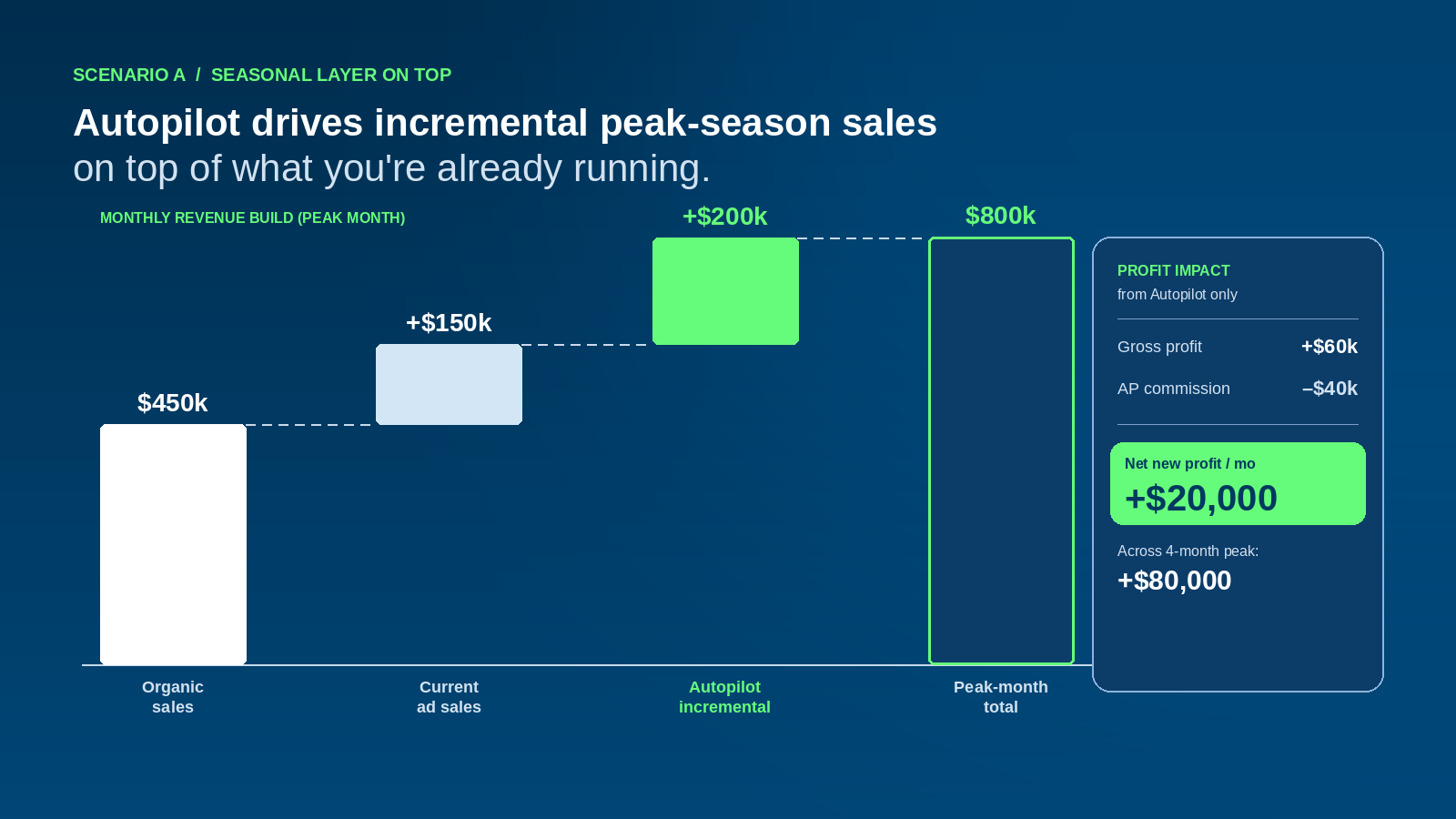
Autopilot comes in during the peak windows and captures that demand on top of what you already run. This is fully incremental: Autopilot will only go after Sponsored Product keywords or prompts that are currently not targeted by your ads.
Assumptions
The monthly P&L during a peak month
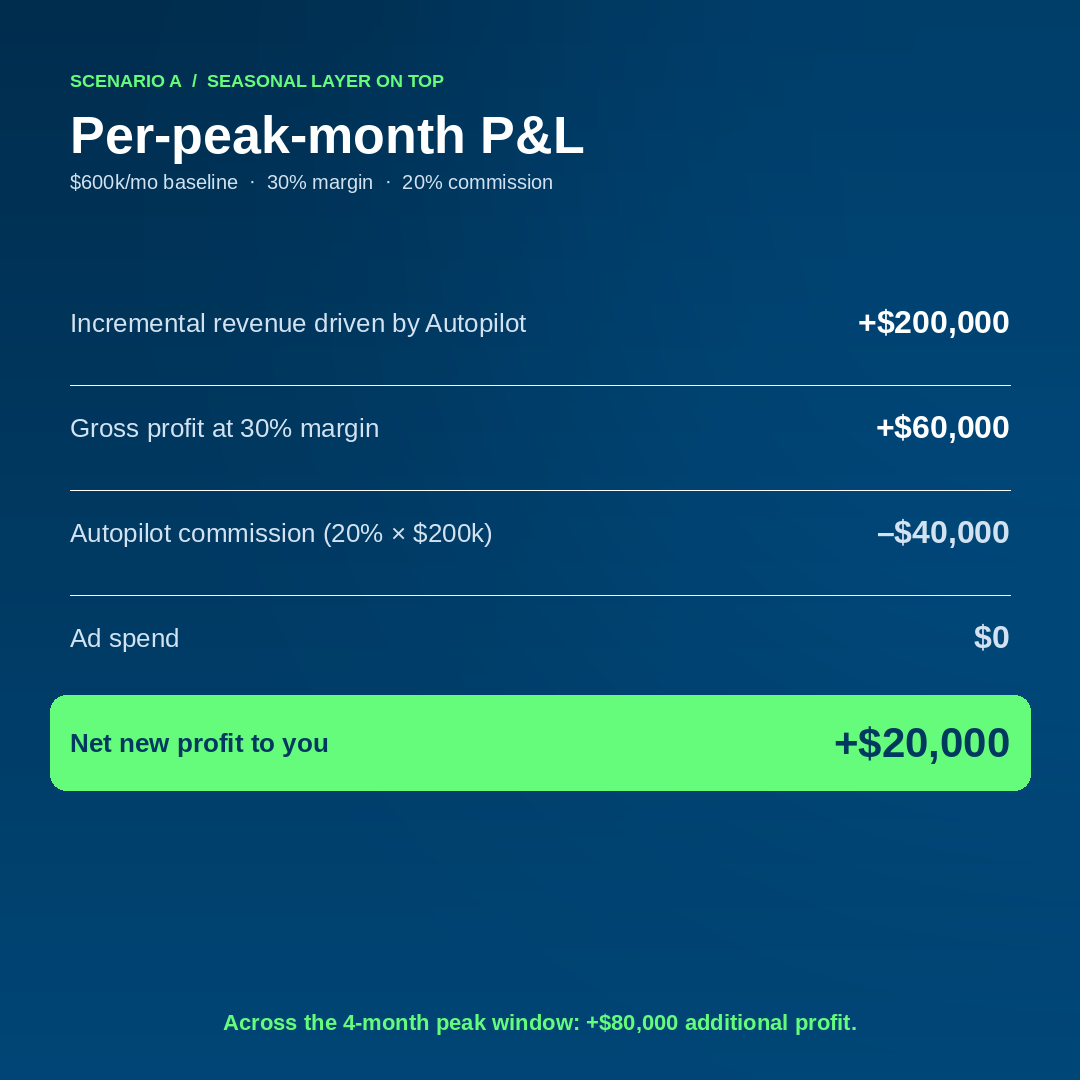
Across the four-month peak window (Mother's Day → Back to School), that's $80k of additional profit you wouldn't have captured otherwise, with zero disruption to what your team is already running, zero ad spend on your side, and zero commitment outside the peak window.
The setup. Your organic sales are solid but you're either not running paid at all, running it cautiously, or running it on a fraction of your catalog. Or you are unhappy on how your current ads provider is generating returns. You'd like to turn it on properly, but the economics are frustrating: a traditional agency wants a $5k+ monthly retainer before a single click is bought, and your internal case for an ad budget is always one missed quarter away from being cut.
In this scenario Autopilot is effectively the paid layer: we fund it, we run it, and we only get paid when it works.
Assumptions
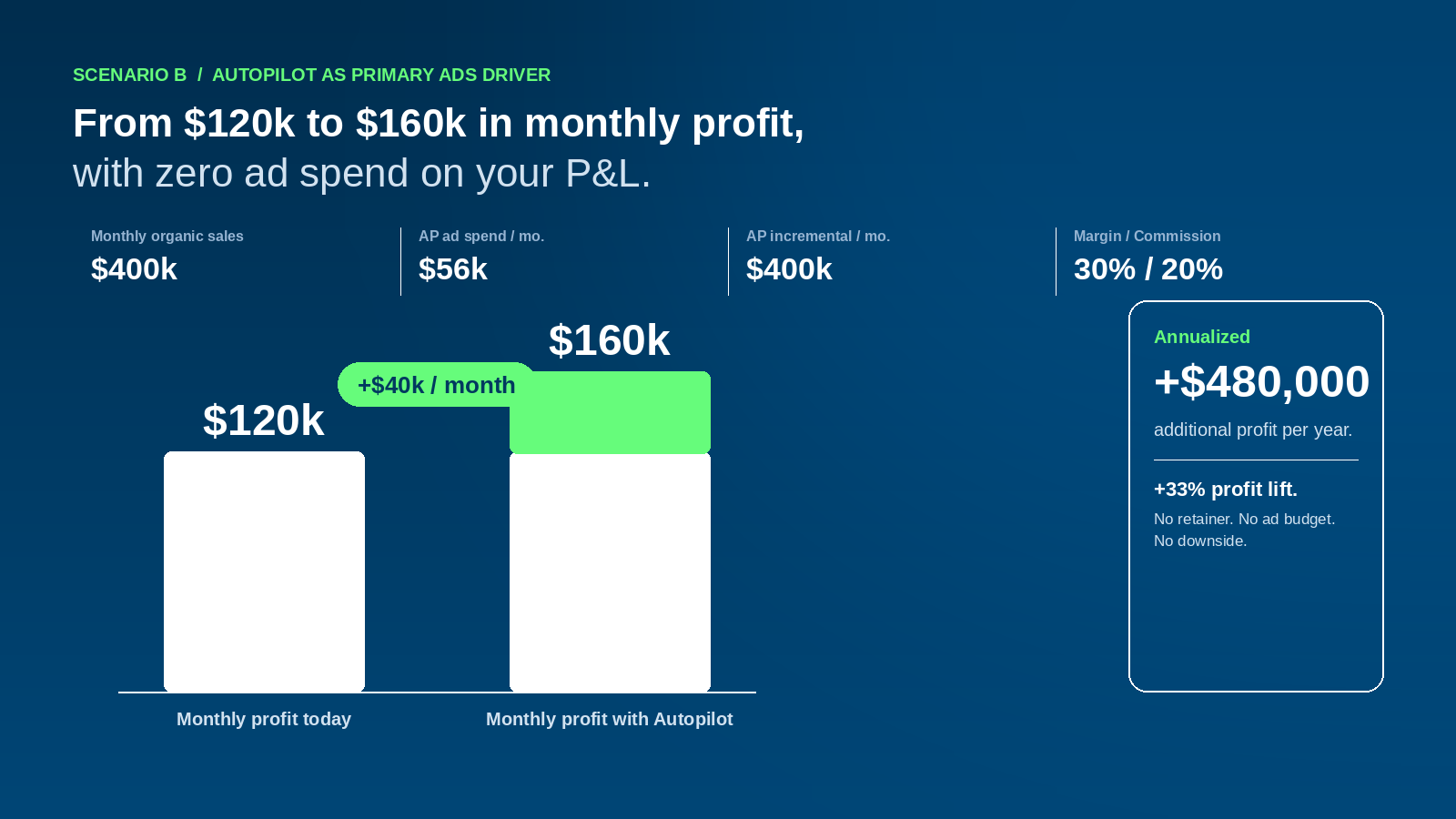
The monthly P&L
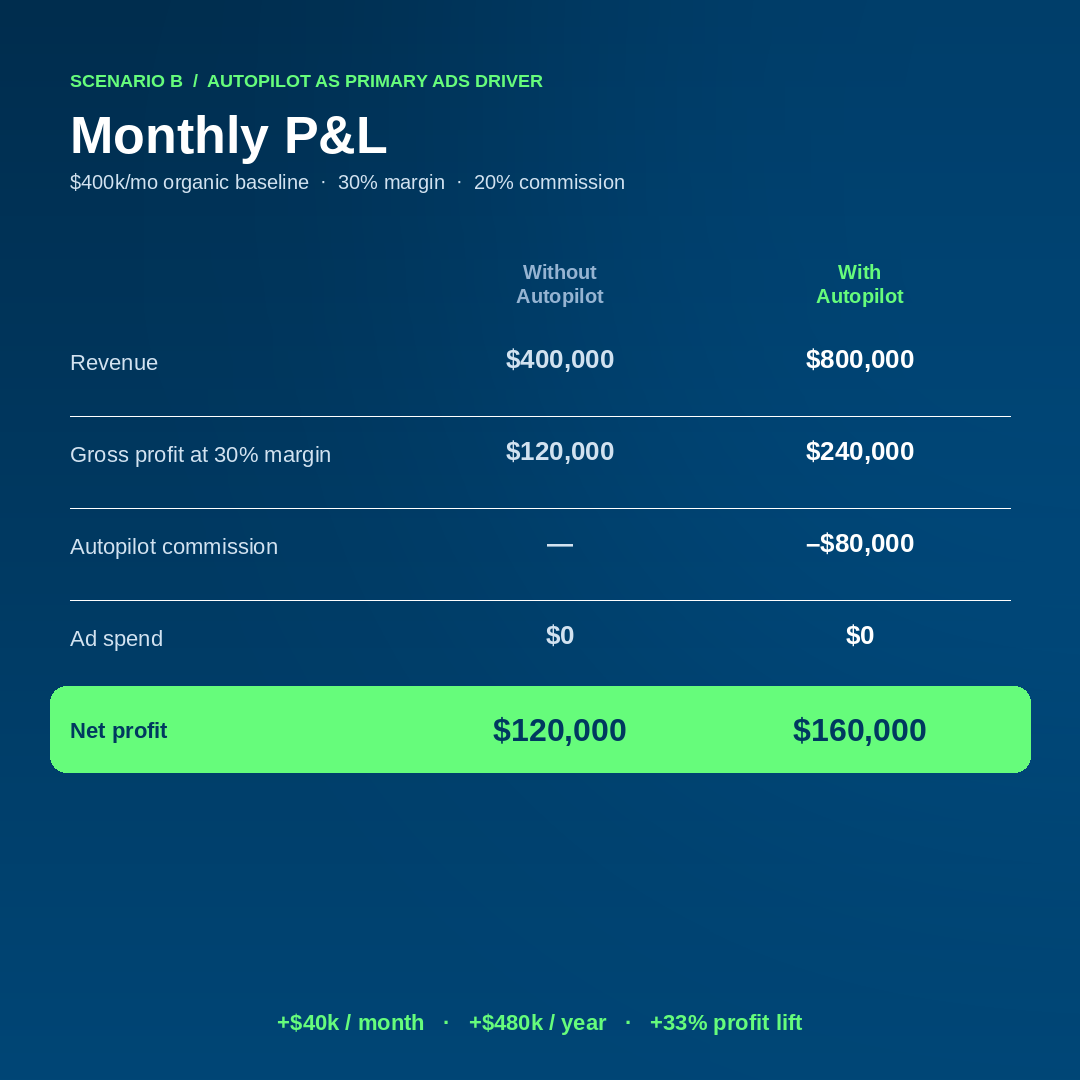
That's +$40k of profit per month at the current run-rate - $480k annualized.
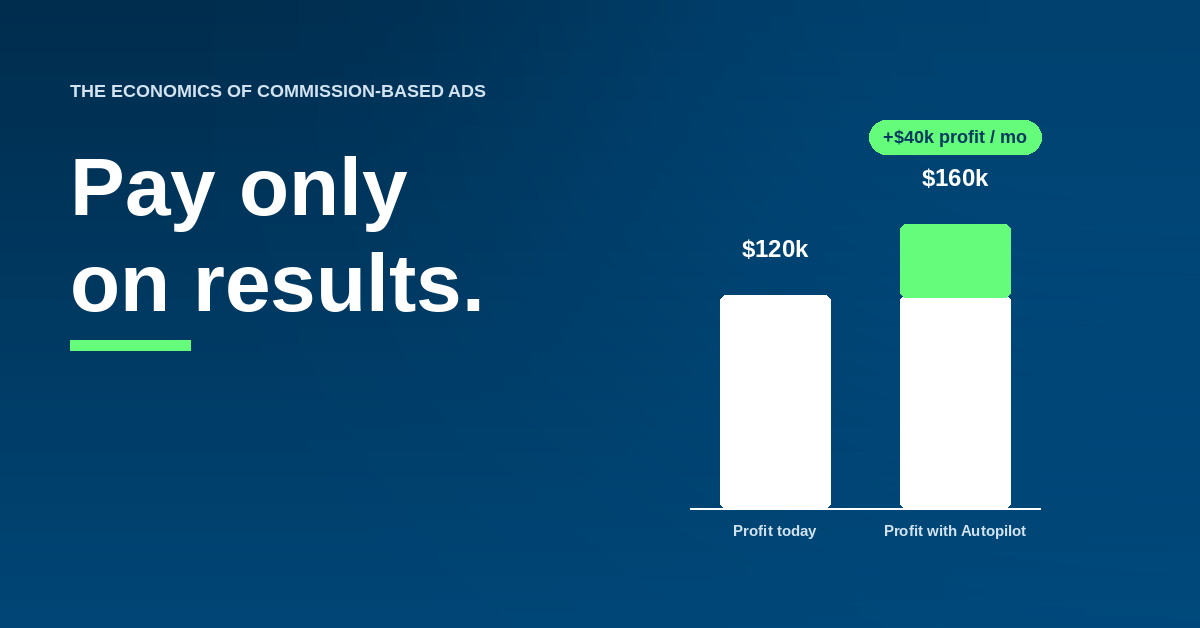
No upfront commitment, no retainer, no ad budget on your P&L, and no downside if we underdeliver. You move from $120k/month in profit to $160k/month, a 33% increase, without touching your cash flow.
You might be wondering how this is sustainable on our end. The answer lies in our keyword bank and seasonal models that we have developed and finetuned over the last 3 years. We only win when the optimizations compound and you decide to keep us engaged year-round. The incentive alignment is the whole point.
On your side, the math cleans up into three things worth naming:
You never spend before you earn. Every dollar of Autopilot-generated revenue arrives with a cost already deducted. There is no budget to defend internally, no cash outlay waiting to prove itself, and no scenario where you pay for ads that didn't work.
Your downside is zero. Your upside is asymmetric. If we drive nothing, you pay nothing and we absorb the ad spend we already put in. If we drive a lot, you pay a percentage of actual sales. The shape of the deal is designed so that the floor is unchanged and only the ceiling moves.
The compounding effect isn't on the invoice. The numbers above only show the paid lift. They don't price in the flywheel: better-optimized listings rank higher organically, which means lower future TACOS, more non-attributed sales, and a structurally stronger catalog. That's the part you keep.
For a $400k/month brand, a commission-based setup adds roughly $480k per year of profit with no additional risk. For a $600k/month brand adding Autopilot only during peak season, it adds $80k of pure-upside profit across four months. In both cases the cost of trying is zero and the deciding factor isn't budget, it's how quickly you want to start.
If you want us to run the same math against your actual numbers, we'll audit your catalog, model the expected lift, and show you what a peak-season run with Autopilot would look like on your P&L. No retainer, no commitment, no ad spend on your side.
Run you brand evaluation now - we pay for the ads, you pay only on results.
Autopilot, Inc. is an Amazon listing optimization and AI discovery service. Since 2023 it has published more than 2 million listing updates for 450+ brands.
Agentsites is a trademark or registered trademark of EverythingMachines.