Your customers are already telling you what to bundle. Every co-purchase, every "frequently bought together" signal, every market basket pattern: Amazon tracks all of it across hundreds of millions of transactions. That data is sitting in your Brand Analytics dashboard right now.
A shampoo and a conditioner. A set of resistance bands and a yoga mat. A kids' lunchbox, a water bottle, and a set of ice packs. These aren't hypothetical pairings. They're actual transaction patterns ; products your customers are already putting in the same cart. The only question is whether you're capturing that intent in a single listing, or letting Amazon surface those pairings on your product detail page as a launchpad for your competitors' ads.
A virtual bundle is a single listing that combines 2–5 of your existing FBA products into one purchasable unit. Amazon picks and ships each item separately from your current inventory. There's no new packaging, no new shipment plan, no additional storage fees. You create the listing, set a price (with or without a discount), and it goes live within 24 hours.
That's it. No supply chain change. No new SKU in your warehouse. Just a new listing that captures demand you're currently missing.
The catch - and it's a meaningful one - is that most brands either don't create bundles at all, or create them based on intuition rather than data. The result is a graveyard of low-performing bundles that sit on page 12 and do nothing, which is why the feature has a reputation for being underwhelming. The feature isn't the problem. The selection logic is.

Product bundling has been studied in economics and marketing research for decades. Bakos and Brynjolfsson's foundational work at MIT (Bundling Information Goods: Pricing, Profits and Efficiency", Management Science, 1999) demonstrated that bundling makes aggregate demand far more predictable than individual product demand ; which means data-driven bundle selection reliably outperforms intuition, often by a wide margin. On a personal note: Erik Brynjolfsson was my professor at MIT, and his work on information goods and bundling strategy is part of what shaped how we think about catalog-level optimization at Autopilot.)
Separately, research on consumer decision-making has shown that bundles convert better in part because they reduce search costs: a shopper who finds a bundle doesn't need to locate, evaluate, and add two or three products separately. On Amazon, where every click is a chance to lose the customer to a competitor's Sponsored Product, that friction reduction translates directly into conversion.
The academic literature established the "why." What Amazon added is the "with what data." Brand Analytics now gives brand-registered sellers access to co-purchase signals, search query performance, and market basket data at the ASIN level. The ingredients for smart bundling are available to every brand owner. The question is who's actually using them.
This is where our approach differs from the standard playbook of "pick two products that seem complementary and list them together."
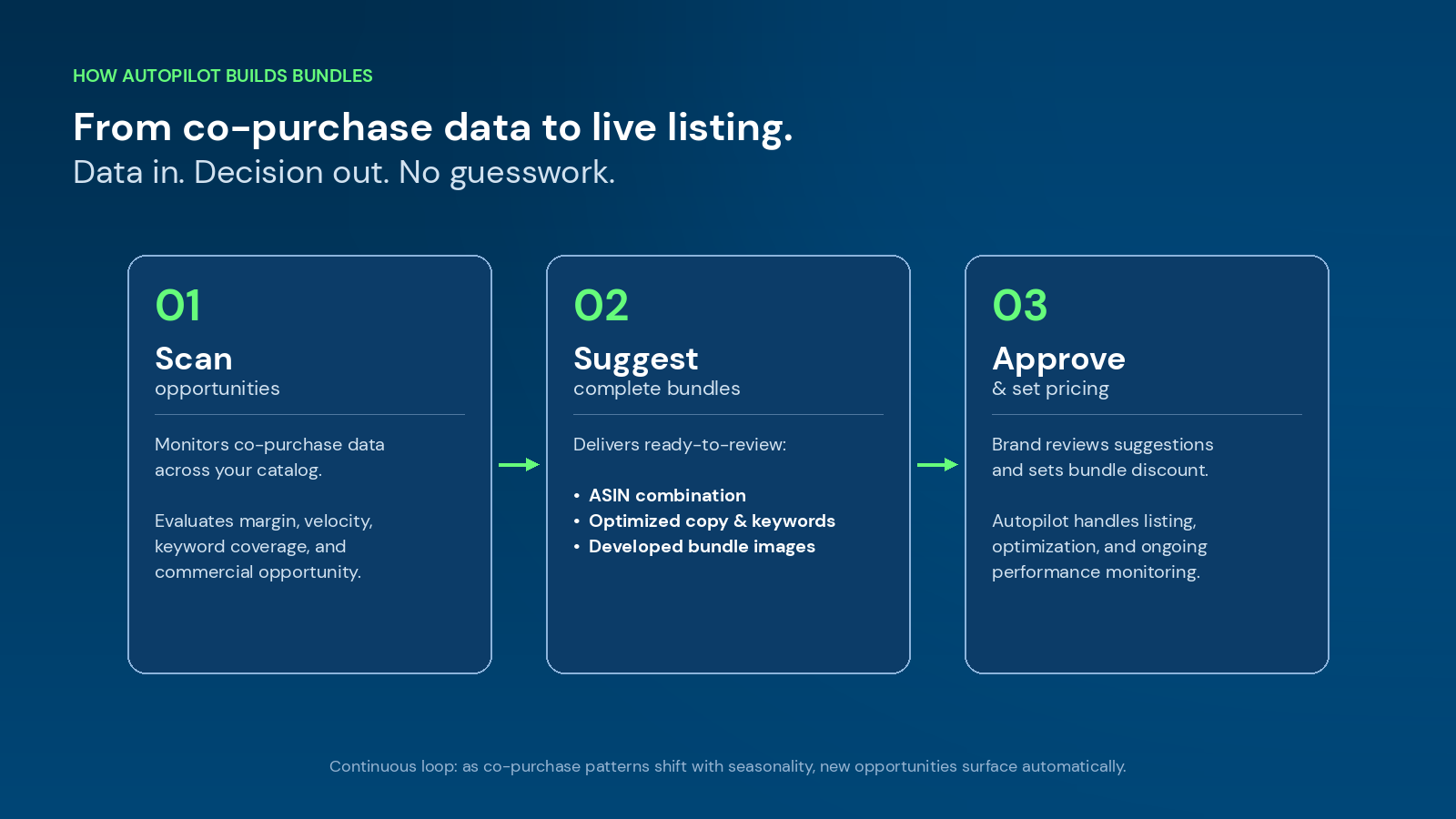
Step 1 ; Scan for opportunities. Autopilot continuously monitors co-purchase data across your catalog to identify which products shoppers are already buying together. We're not guessing at complementarity ; we're reading the actual transaction patterns and evaluating the commercial opportunity: margin, velocity, keyword coverage, and whether a bundle would open up search terms your standalone listings can't reach.
Step 2 ; Suggest complete bundles. For each opportunity that clears the threshold, Autopilot delivers a ready-to-review package: the ASIN combination, optimized bundle copy and keywords (targeting "set," "bundle," "kit," and the long-tail intent phrases that only a multi-product listing can rank for), and developed bundle images that present the products as a cohesive unit rather than a collage of individual hero shots.
Step 3 ; Brand approves, sets pricing. You review the suggestions, clear what you like, and set the bundle discount (if any). Autopilot handles the rest ; listing creation, keyword optimization, ongoing performance monitoring, and refresh cycles as co-purchase patterns shift with seasonality.
The entire loop is data-in, decision-out. No guesswork on which products to pair. No manual keyword research for bundle-specific terms. No scrambling to build creative assets.
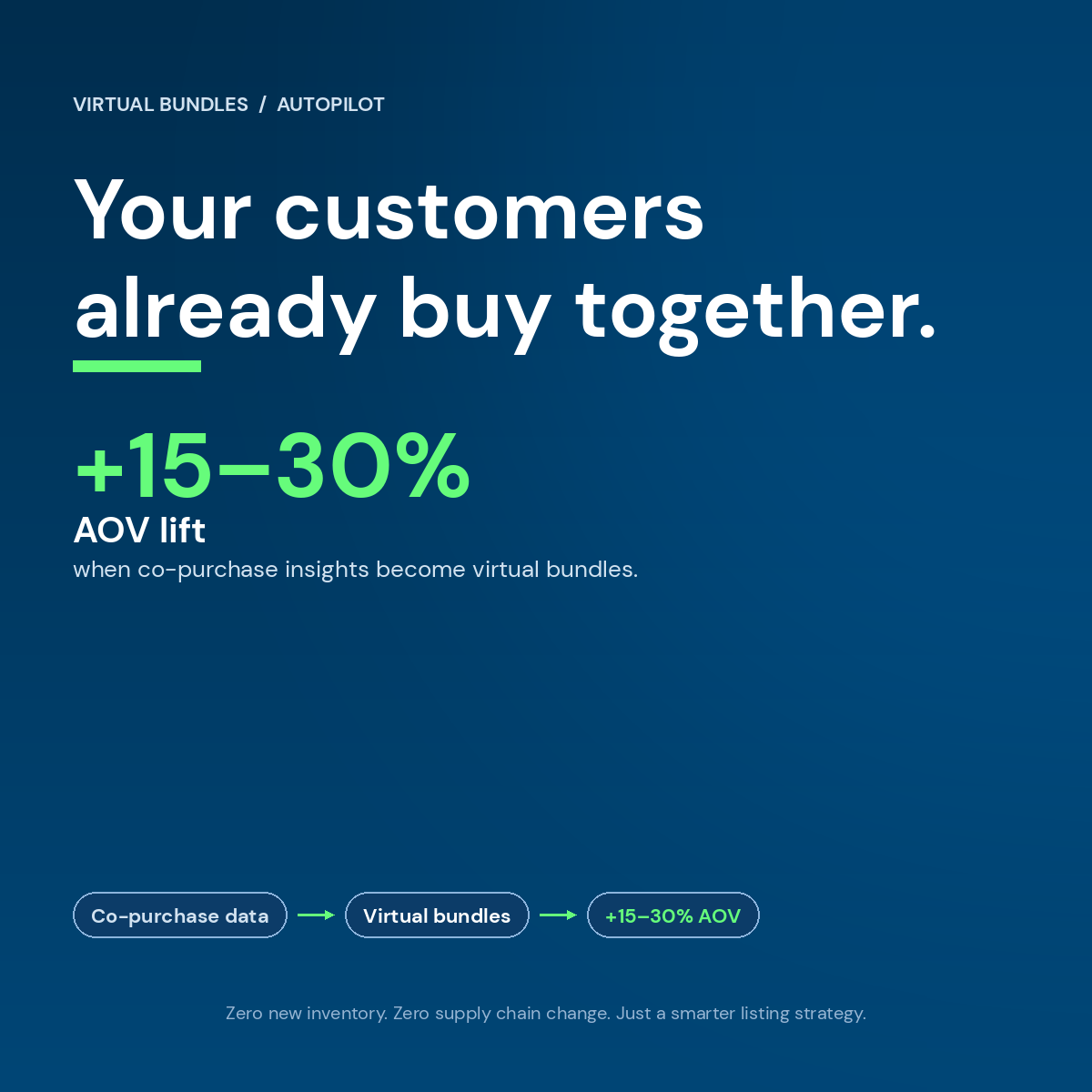
The obvious benefit is average order value. A customer who would have bought one product now buys two or three in a single transaction, and you can track the lift directly in Amazon's bundle sales reports. Agencies and sellers who run data-driven bundle strategies consistently report 15–30% AOV increases, with the strongest results coming from bundles built on actual co-purchase patterns rather than intuition.
But AOV is only the first-order effect. There are three others that compound over time.
You get another listing on the search results page. Every bundle is its own indexed ASIN with its own keyword set. A brand with three bundles can hold four or more organic positions on a single search results page ; your standalone product plus each bundle that matches the query. That's physical SERP real estate your competitors can't occupy. It's not an ad. It doesn't cost per click. It's an organic listing you own.
You unlock search terms your standalone listings can't reach. Shoppers search for "resistance band set with yoga mat," "complete lunchbox kit for kids," "skincare routine bundle." Those are real queries with real volume ; and a standalone listing for a single product has no business ranking for them. A bundle does. Autopilot specifically optimizes bundle copy to capture these multi-product intent terms, which means every bundle you launch expands the total keyword surface area of your catalog.
You take back your own product detail page. This is the one most brands don't think about until they see it. On any product detail page, Amazon allocates space for "frequently bought together" recommendations and Sponsored Product ads from competitors. When you create a virtual bundle, it appears in a dedicated widget on your PDP ; above the Sponsored Product placements. That means your bundle occupies real estate that would otherwise go to a competitor's ad. You're not just adding visibility; you're removing a competitor's opportunity to poach your traffic at the point of highest purchase intent.
One operational reality worth flagging: if any single component of a virtual bundle goes out of stock, the entire bundle listing disappears until inventory is restored. For brands running tight on a hero SKU during peak season, this can quietly kill a high-performing bundle at exactly the wrong moment.
Autopilot monitors inventory at the catalog level, so we flag stock-risk bundles before they go dark. But it's a constraint worth understanding when you plan which products to pair ; bundles built on your most stable-inventory ASINs perform more consistently than bundles anchored to products that regularly sell through.
The instinct is to discount aggressively to drive bundle adoption. The data says otherwise. Bundles priced at a 5–15% discount relative to buying the components separately tend to perform well without cannibalizing standalone listings. Push the discount past 25–30% and you risk training customers to wait for the bundle instead of buying the individual product, which erodes your baseline.
Autopilot models the margin impact before suggesting a bundle price, so you're making a pricing decision with full visibility into how it affects your P&L ; not guessing at a number that "feels right."
A brand running 30 ASINs might have five strong bundle opportunities based on co-purchase data. Each bundle adds an indexed listing to the catalog, captures a cluster of search terms the standalone products miss, and occupies defensive real estate on the PDP. If even two of those bundles gain traction, the catalog is generating more revenue per session, ranking for more queries, and giving competitors fewer openings ; all without a single new product being manufactured or shipped.
That's the compounding effect: more listings, more keywords, more PDP control, higher AOV, and a structurally stronger catalog. And because Autopilot continuously scans co-purchase data, the bundle portfolio evolves as shopper behavior shifts ; seasonal pairings get surfaced before peak, underperforming bundles get flagged, and new opportunities get identified as your catalog grows.
Your customers are already buying together. The co-purchase data proves it. The brands that turn those signals into virtual bundles are seeing 15–30% AOV lifts, expanded SERP coverage, and a structural defensive advantage on their own product detail pages ; all without manufacturing, shipping, or warehousing a single new product.
The feature has been available to brand-registered sellers for years. What's been missing is the data layer to do it well and the creative pipeline to do it at scale. That's what Autopilot builds. We scan the co-purchase data, identify the opportunities, deliver ready-to-approve bundles with optimized copy, keywords, and images, and monitor performance over time. You approve what you like and set the price. We handle everything else.
If you want to see which bundle opportunities your co-purchase data already supports, we'll run the analysis. No cost, no commitment - just the data.
Autopilot is an Amazon listing optimization and AI discovery service. Since 2023 it has published more than 2 million listing updates for 450+ brands.