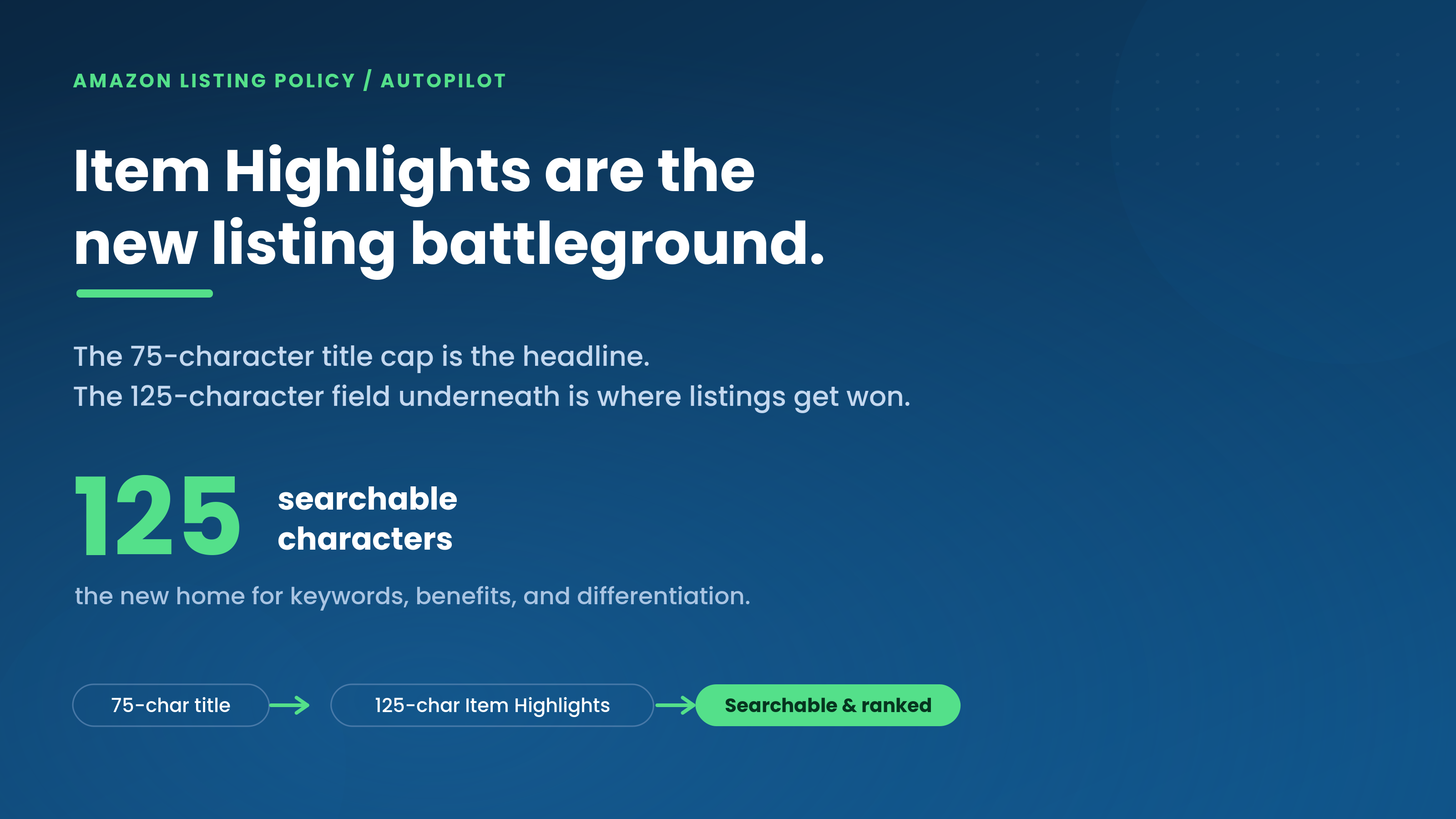
Every brand on Amazon is talking about the same thing right now. Starting July 27, 2026, product titles in every category except media must be 75 characters or less, including spaces, down from the 200 characters brands have written to for years. It's a real change, and we'll cover what it requires. But the title cap is the part everyone can see, which is exactly why it matters least to your long-term performance.
The story that matters is the field Amazon introduced to absorb the overflow: Item Highlights, a new searchable field that adds 125 characters for product details like materials and recommended use cases, displayed beneath your title in both search results and on the product detail page.
Notice the imbalance. Amazon's published policy goes into meticulous detail about titles: character limits, special-character rules, capitalization, word repetition, information order, parent and child handling. On Item Highlights, it says almost nothing. A couple of sentences and one example, turning "USB-C, PPS Support, Cable not included" into comma-separated phrases instead of a long title.
So Amazon just made a brand-new, searchable, catalog-wide content field a permanent input into discovery, and gave brands almost no guidance on how to use it well. That gap is the single biggest opportunity in this policy change. Brands that fill those 125 characters deliberately will gain share. Brands that dump leftover keywords there, or let Amazon's AI fill them generically, will quietly lose it.
That's the real battleground, and for Autopilot customers it's already handled.
Lead with the most important thing. The transition to 75-character titles and Item Highlights is a done-for-you experience. You don't need to audit your catalog, learn the new field, or race Amazon's AI to the deadline. We're handling the migration for every ASIN under management, including the Item Highlights work that Amazon's documentation doesn't attempt to explain.
This is the difference between controlling your catalog and being at the mercy of an algorithm that doesn't know your brand. After July 27, any title still over the limit gets rewritten by Amazon's AI, gradually, with a 14-day window for brand owners to review each change before it goes live. If you do nothing, the machine's version becomes your listing. And the machine optimizes for fit and clean display, not for which of your keywords convert, which differentiator wins your category, or how your Item Highlights should read heading into Q4.
Autopilot knows all of that, because we've been reading the performance data on your listings the entire time. So while the rest of the marketplace treats July 27 as a fire drill, Autopilot customers get previews to react to, a managed publishing schedule, and continuous tuning of the field that moves the needle.
The title is now a precision instrument, not a keyword dumping ground. To stay compliant, a title must:
Stay within 75 characters including spaces (all product types except media; the rules don't apply in Saudi Arabia, Egypt, Türkiye, or the UAE). Avoid promotional phrases like "free shipping" or "100% quality guaranteed." Avoid prohibited special characters and decorative symbols. Avoid repeating any word more than twice, a limit that now applies to brand names too. Drop subjective commentary like "Hot Item" or "Best Seller," skip all caps, use numerals instead of spelled-out numbers, and order information the way a shopper scans it: brand, style or flavor, product type, key attribute, color, size or pack count, model number.
That's the title game now: lead with what matters, cut everything else. It's a one-time structural fix, and any competent tool, including Amazon's own, can shorten a string. The harder question is what to do with everything the title can no longer hold.

When you cut a title from 200 characters to 75, you're not just trimming fat. You're evicting materials, use cases, comparison detail, and a stack of keywords that used to carry your search ranking. All of that intent has to go somewhere. Amazon's answer is Item Highlights, the new home for the keyword, benefit, and differentiation work the title can no longer do.
A few things make this field strategically different from the title.
It's searchable. Item Highlights aren't cosmetic overflow. They feed discovery and appear beneath your title in search results and on the detail page. That makes them a genuine ranking and conversion surface, so how you fill them directly affects whether you get found and whether you get chosen.
It has a specific format. Amazon is explicit on one point: Item Highlights should be written as comma-separated phrases, not full sentences. The official example replaces a bloated title with "USB-C, PPS Support, Cable not included." Short, scannable, keyword-dense fragments, a different writing discipline than titles or bullets.
It's almost entirely undocumented. Beyond "use comma-separated phrases for materials or use cases," Amazon offers no real guidance. There's no playbook for balancing keywords against differentiation, no instruction on which 125 characters convert, no mention of how the field should shift with seasons. That silence matters. It means every brand is improvising, and improvisation across a large catalog produces inconsistent, underperforming listings.
This is exactly the kind of problem Autopilot exists to solve: a high-stakes, data-rich, ongoing optimization task with no clear rulebook, replicated across thousands of ASINs.
Item Highlights live in the listing as the title_differentiators attribute. We don't generate them by shortening your old title or guessing at complementary phrases. We generate them from everything we know about the product and the shopper, then constrain the output to be compliant and correctly formatted. Every Item Highlight Autopilot produces is:
Grounded in item facts and unique selling points. We start from what's true about the product and identify its core benefits and the differentiators that matter against the specific competitors it ranks beside. The point of these 125 characters isn't to describe the product. It's to articulate why this product wins for this shopper, in scannable comma-separated phrases.
Built on two years of historical keyword and sales data. We look back across two years of search and sales performance to find the terms that have driven real purchase share, not just impressions. With only 125 characters to spend, every phrase has to earn its place.
Informed by demographics, shopper intent, reviews, and the AI discovery layer. We fold in demographic insights, shopper-intent signals, the conversational patterns emerging through Alexa Shopping, customer reviews, and your existing listing content. Reviews are especially valuable, telling you in the customer's own words which benefits and use cases actually matter, which is the raw material a comparison-oriented field is built to surface.
Held to strict compliance control. Every highlight is balanced across keywords, benefits, and brand and product differentiators, then checked against Amazon's content policies and your regulatory fact sheets before it goes live. In categories like supplements, beauty, and food, claims are cross-referenced against approved regulatory documentation. Compliance isn't a final gate; it's a constraint we optimize within from the first draft.
The result is 125 characters that do real work. They rank for terms your shortened title can no longer carry, answer the questions shoppers are actually asking, and assert your differentiation at the moment a customer is comparing you to the alternative beside you.
This is the point most coverage of the policy misses, and the one that determines who gains share.
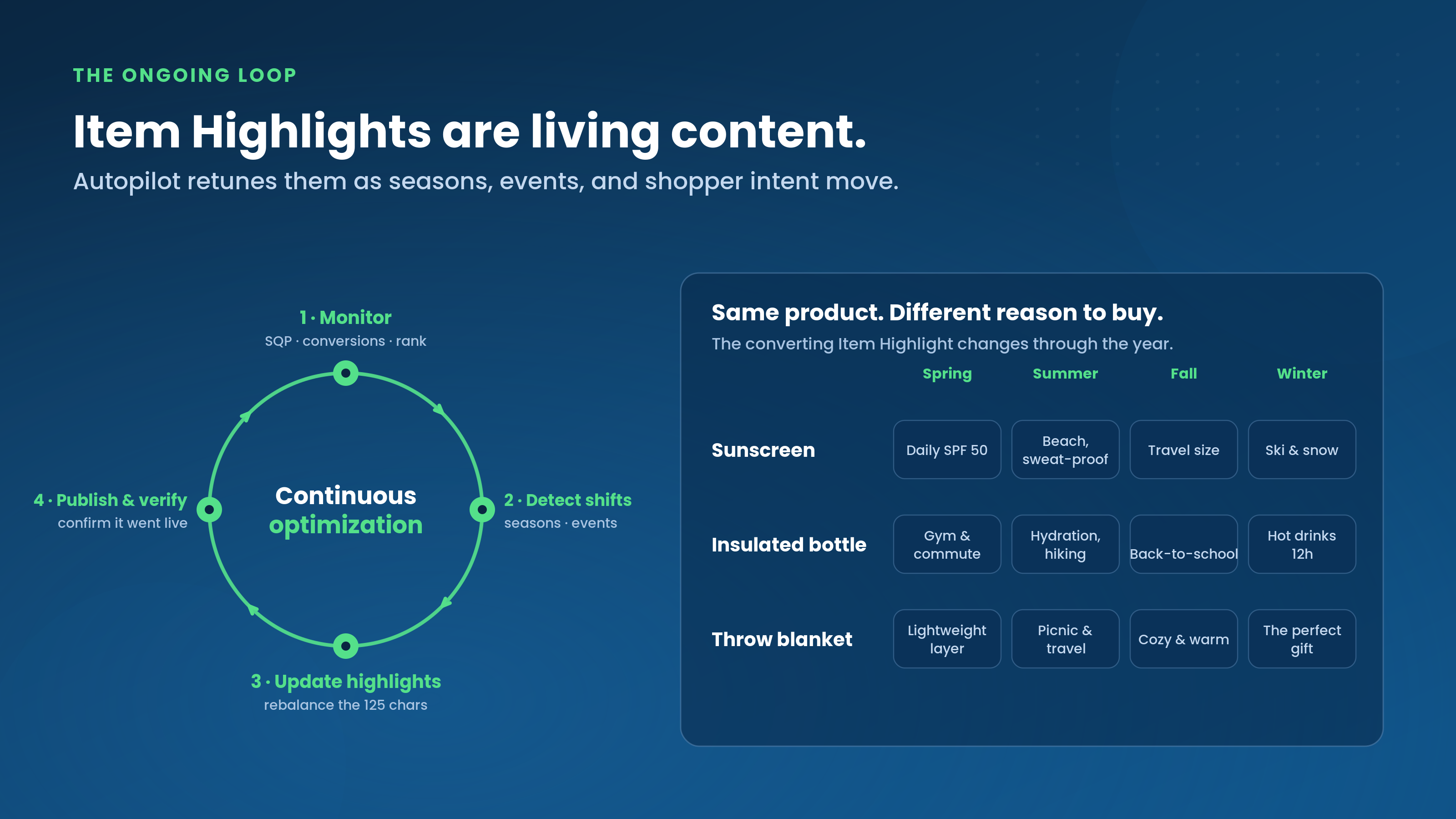
Rewriting a title to fit 75 characters is a one-time task. Composing a first version of your Item Highlights is also a setup step. But Item Highlights are now living content on a searchable field, and living content drifts out of alignment with the market the moment you stop tending it. The valuable work isn't the initial fill. It's the continuous tuning that keeps those 125 characters matched to how shoppers actually search and buy, week after week and season after season.
Consider what changes underneath a static Item Highlight. The queries driving purchase share shift quarter to quarter. Competitors enter, exit, and reposition. Amazon's content rules change without notice. And the reason a customer buys swings with the calendar. A field set once in July is already stale by October.
Seasonality alone makes manual maintenance untenable at scale. A sunscreen is daily skincare in March and a travel essential in June. An insulated bottle is gym gear in January and a back-to-school item in August. A blanket is "soft and cozy" most of the year and "the perfect gift" in December. The product doesn't change, but the converting highlight does. Autopilot adjusts Item Highlights on seasonal cadences, rotating emphasis ahead of category demand spikes and tentpole events so your 125 characters always speak to why someone is buying right now. A brand doing this by hand across a large catalog would need a content calendar, a keyword analyst, and a compliance reviewer working in lockstep all year. We do it continuously, in the background, grounded in when the data shows demand actually moves.
That ongoing loop, not the one-time fix, is where the value compounds, and it's what a done-for-you system is built to deliver.
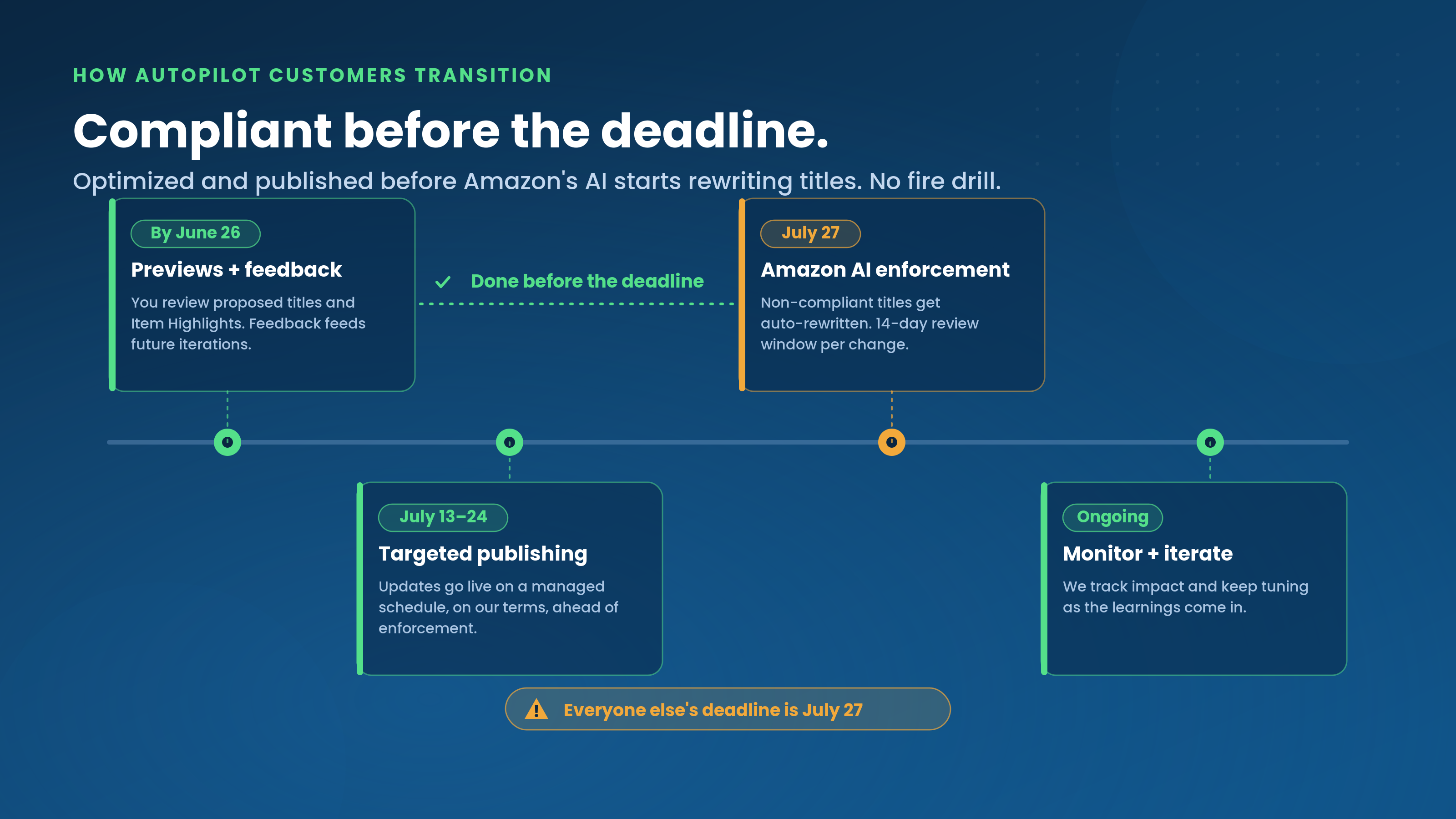
We've built the migration around one principle: get our customers compliant and optimized before Amazon's AI starts rewriting titles on July 27, so you're never reacting to a machine-generated version of your own listing.
By June 26 2026, previews and your chance to weigh in. Every Autopilot customer will see previews of their new titles and unique selling points before anything is published. You review the proposed titles and Item Highlights and give feedback, and that feedback isn't a one-off approval step. Autopilot incorporates it into future iterations, so the system learns your preferences and gets sharper over time. This is the inverse of Amazon's flow, where the AI proposes and you have 14 days to object. With us, you shape the direction up front.
July 13 to 24 2026, targeted publishing. We publish the updates on a managed schedule across this window, ahead of Amazon's July 27 enforcement date. Publishing early means your listings transition on our terms, with content we engineered, rather than being swept up in Amazon's gradual automated rewrites. Your listings stay active throughout.
After publishing, performance monitoring and iteration. Once the new titles and Item Highlights are live, we monitor performance and impact closely and iterate as learnings from the transition come in. A title and highlight change is a hypothesis. The live data tells us whether it was right, and we adjust based on what we observe rather than what we assumed.
Throughout, bullets aligned to the new structure. Your bullet points get updated to align with your top USPs and to expand on the Item Highlight call-outs with added context for shoppers. The title, Item Highlights, and bullets then work as one coherent message: the short title hooks, the highlights carry the searchable, comma-separated differentiation, and the bullets give the shopper the full story.
By the time Amazon's enforcement date arrives, Autopilot customers are already compliant, already optimized, and already collecting performance data to inform the next iteration. No fire drill, because the work was done early and is now in continuous improvement.
It's worth being clear-eyed about the alternative, because the policy forces a real choice, and Item Highlights make it harder than it looks.
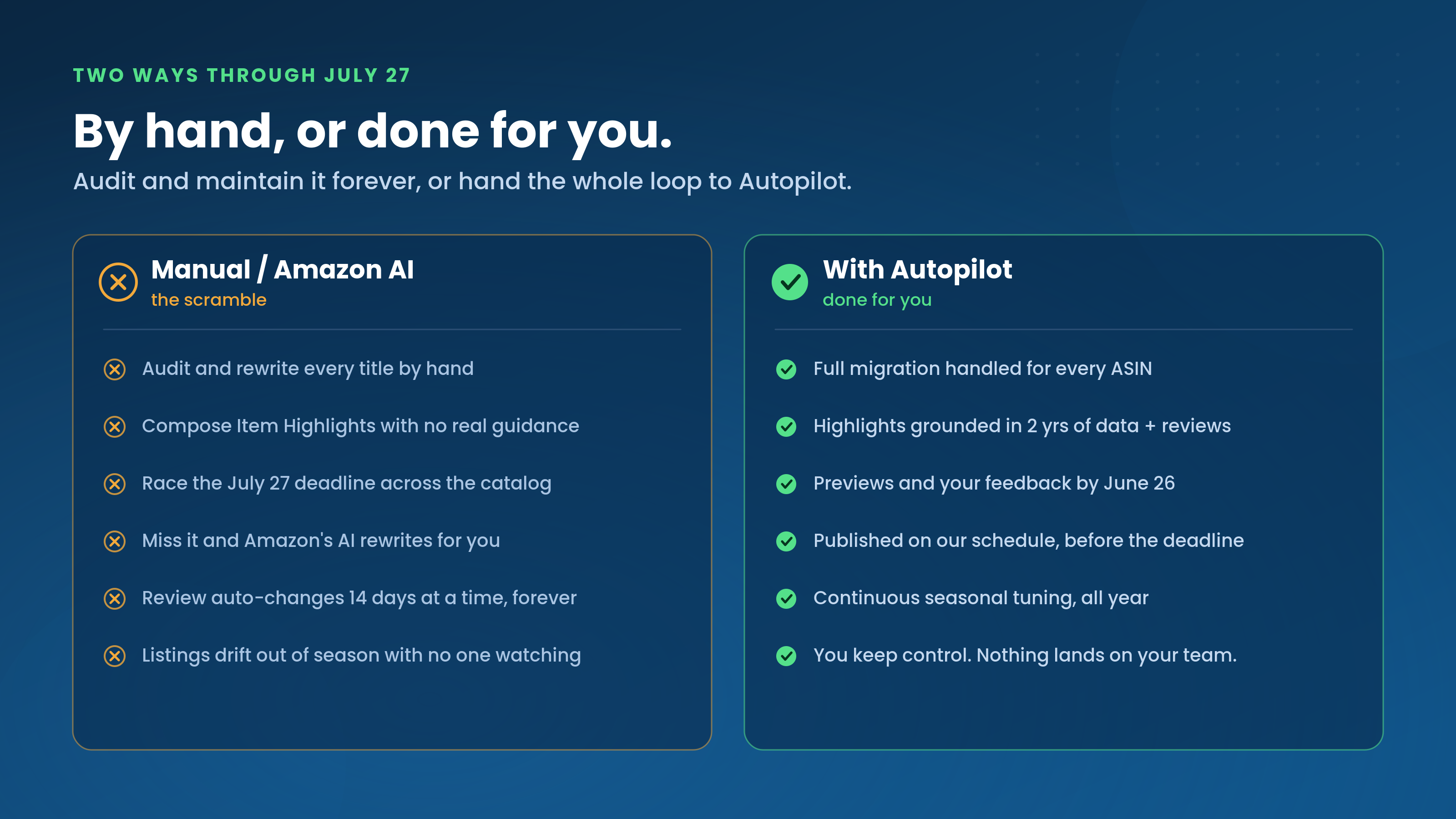
If you handle this manually, you face a binary. Either you invest the labor, auditing every title, rewriting each to 75 compliant characters, then composing a well-balanced, correctly formatted Item Highlights field for each ASIN with almost no guidance from Amazon, and maintaining all of it as the market and seasons shift. Or you let Amazon's AI do it and accept whatever it produces, reviewing changes 14 days at a time as they roll across your catalog.
For a small catalog, the manual path is doable. For a large catalog, it's a significant, recurring operational burden, and the maintenance never stops because Item Highlights are living content. The AI path removes the labor but also removes your control. The machine optimizes for fit, not for your conversion data, your differentiation, or your seasonal strategy. And because rewrites happen gradually with a rolling review window, "just letting Amazon handle it" means monitoring a steady stream of changes indefinitely.
Either way, the uncertainty and the manual work land on your team. That's the gap Autopilot closes: the control of a fully managed, data-grounded migration without the labor, plus the ongoing optimization that turns a compliance requirement into a ranking advantage.
Amazon's title policy is a small change with a large signal inside it. The marketplace is moving toward structured, searchable, AI-readable content: short human-friendly titles up top, machine-parseable differentiation underneath. Item Highlights, comma-separated and fact-grounded, is part of the same trajectory as Alexa Shopping and COSMO-driven discovery. Amazon wants listings an AI can read, compare, and recommend, not keyword walls written for a 2018 search algorithm.
The brands that win under this regime won't be the ones that shortened their titles fastest. They'll be the ones whose Item Highlights are continuously grounded in live shopper data, structured for how AI parses a listing, and tuned as intent and seasons move. Amazon gave everyone the field and almost no instructions. The advantage goes to whoever uses it best, and keeps using it best, every week, across the whole catalog. That's a permanent operating capability, not a July project, and it's what Autopilot delivers.
The title cap is the deadline. Item Highlights are the real game. Autopilot customers are already playing it.
If you're already on Autopilot, your previews are on the way by June 26. Review them, send feedback, and we'll take it from there. There's nothing else you need to do.
If you're not on Autopilot and you're staring at a large catalog and a July 27 deadline, we'll run a free audit of your titles and Item Highlights and show you which listings are over the limit, what your 125 characters should say, and where the keyword and differentiation opportunities are. No cost, no commitment, just the data you'd need to make the call either way.
What exactly is changing on July 27, 2026? Amazon is capping product titles at 75 characters including spaces in every category except media, down from the previous 200-character standard. The rules apply across stores except Saudi Arabia, Egypt, Türkiye, and the UAE. Titles also can't use promotional phrases, prohibited special characters, all caps, subjective commentary like "Best Seller," or any word more than twice (brand names included).
What are Item Highlights? Item Highlights is a new field that adds 125 characters for product details like materials and recommended use cases. It's searchable and appears beneath the title in search results and on the product detail page. In the listing schema it maps to the title_differentiators attribute.
How should Item Highlights be written? Amazon specifies comma-separated phrases, not full sentences. Their example replaces a long title with "USB-C, PPS Support, Cable not included." The goal is short, scannable, keyword-relevant fragments that help customers compare options, a different writing discipline than titles or bullets.
Why is the Item Highlights field such a big deal if Amazon barely documents it? Because that's exactly why it matters. Amazon made a searchable, catalog-wide field a permanent input into discovery and gave almost no guidance on how to use it well. Brands that fill those 125 characters deliberately, balancing keywords, benefits, and differentiation, and keeping them current, will gain share over brands that treat the field as leftover-keyword storage or let Amazon's AI fill it generically.
What happens if I don't update my titles before July 27? After July 27, Amazon will gradually rewrite any non-compliant title using its AI. Brand owners get a 14-day window to review, modify, and approve each recommendation in Review listing changes before it goes live. Listings stay active throughout, and you can edit titles and Item Highlights at any time in Manage All Inventory. But if you take no action, the AI's version becomes your live listing.
Do I need to do anything if I'm an Autopilot customer? No. Autopilot is handling the full transition for every ASIN under management. You'll receive previews of your new titles and Item Highlights by June 26, you can send feedback that informs future iterations, and we publish on a targeted schedule between July 13 and July 24, ahead of enforcement. After that, we monitor performance and keep iterating.
How does Autopilot decide what goes in Item Highlights? We start from the product's facts and unique selling points, identify the core benefits and differentiators against the competitors it ranks beside, and draw on two years of historical keyword and sales data, demographic and shopper-intent signals, Alexa Shopping discovery patterns, customer reviews, and existing listing content. Every highlight is balanced across keywords, benefits, and differentiation, formatted as compliant comma-separated phrases, and checked against Amazon's content policies and your regulatory fact sheets.
Will my Item Highlights stay the same all year? No, and that's the point. The reasons a shopper buys shift with seasons and tentpole events. Autopilot adjusts Item Highlights on seasonal cadences so your 125 characters always reflect why someone is buying right now, timed to when category demand actually moves.
What happens to my bullet points? Your bullets get updated to align with your top USPs and to expand on the Item Highlight call-outs with added context for shoppers, so the title, Item Highlights, and bullets work together as one coherent message rather than three disconnected fields.
Autopilot is an Amazon listing optimization and AI discovery service. Since 2023 it has published more than 2 million listing updates for 450+ brands.