In our last post we argued that, under Amazon's new title policy, Item Highlights are the new listing battleground. For most categories that story is about risk: titles drop from 200 characters to 75 on July 27, 2026, and anything still over the limit gets rewritten by Amazon's AI or risks suppression if you don't act.
Apparel is the exception. For these categories the same policy flips from defense to offense.
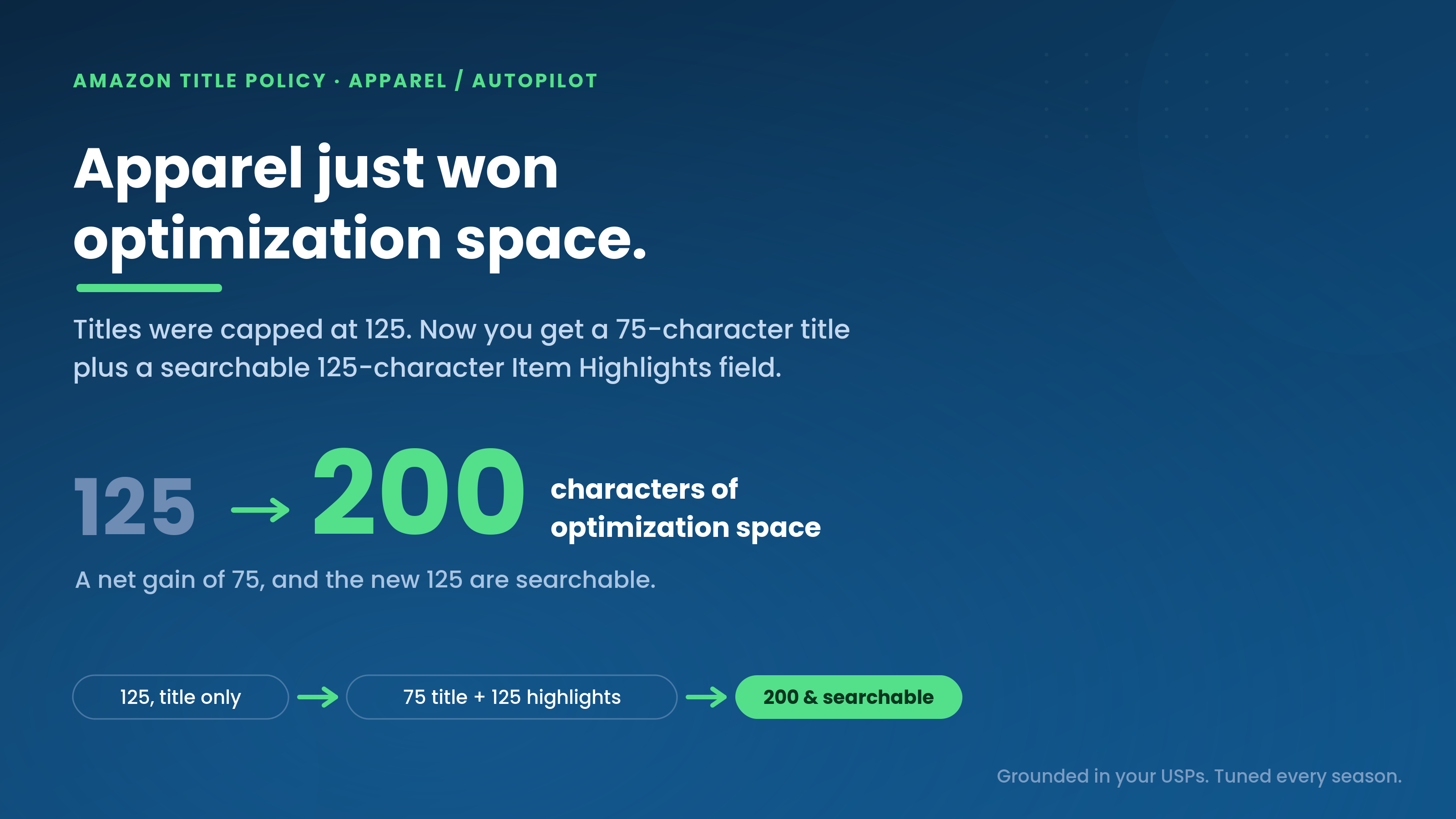
If you sell in apparel, you never had 200 characters to begin with. Amazon caps titles in these categories at 125 characters today. The new 75-character title is a smaller trim for you than for everyone else, and in exchange you gain something you have never had: a dedicated, searchable, 125-character Item Highlights field that sits beneath your title in both search results and on the product detail page.
You go from 125 characters of optimization space to 75 in the title plus 125 in Item Highlights: 200 in total, a net gain of 75. And the new 125 are not a keyword dumping ground. They are searchable, comparison-oriented, and built for the attributes that sell apparel.
The categories affected by this shift include Apparel, Shirts, Pants, Shorts, Skirts, Dresses, Sweaters, Blazers, Suits, Outerwear, Swimwear, Sleepwear, Underwear, Bras, Socks and Hosiery, Adult Costumes, and Accessories. If your catalog lives in any of these, the July 27 change is an opportunity, not a threat, provided you actually claim the new space.
Apparel is the category where the title was always too short. A shopper buying a dress or a pair of leggings decides on fit, fabric, stretch, rise, length, coverage, care, and occasion. None of that fits cleanly in a title that also has to carry brand, product type, color, and size. For years apparel brands have had to choose which two or three attributes to surface and bury the rest.
Item Highlights end that compromise. The attributes that actually drive an apparel purchase are precisely the comma-separated phrases the field was designed for: "Squat-proof, High-waisted, 4-way stretch, Quick-dry, Hidden pocket." These are the details a shopper scans before adding to cart, and now they are searchable and visible at the point of comparison, not hidden three bullets deep.
Same policy, opposite outcome: you are not losing room, you are gaining a discovery surface tailored to how clothing is chosen.
The gift comes with a condition. After July 27, any title still over 75 characters gets rewritten by Amazon's AI, gradually, with a 14-day window to review each change before it goes live. If you do nothing, the machine's version becomes your listing, and Amazon's AI optimizes for fit and clean display, not for which fit-and-fabric attributes convert your shopper.
Worse, a generically filled Item Highlights field wastes the entire opportunity. Amazon gives almost no guidance on how to use the field well, so the brands that treat it as leftover-keyword storage, or let the AI populate it, will quietly hand the advantage to competitors who fill those 125 characters deliberately. The new space only becomes a win if the content in it is grounded in what your shopper is actually looking for.
Take a pair of leggings whose old 125-character title tried to carry everything:
Brand Women's High Waisted Leggings Squat Proof 4 Way Stretch Yoga Pants with Pockets Tummy Control 7/8 Length Workout
Under the new structure it splits into a clean title and a searchable highlights field:
Title (under 75): Brand High-Waisted Leggings, 4-Way Stretch, 7/8 Length, with Pockets
Item Highlights (under 125): Squat-proof, Tummy control, Quick-dry, Hidden waistband pocket, Buttery-soft, Yoga to errands
The same logic applies across the catalog. A dress can carry "Wedding guest, Midi length, Wrinkle-resistant, Side pockets, Machine washable, Lined bodice." Outerwear can carry "Water-repellent, Packable, Thermal-lined, Adjustable hood, Commute-ready." Swimwear can carry "Full coverage, Quick-dry, UPF 50+, Removable pads, Tummy control, Vacation-ready." Every phrase is a reason to buy, a search term, and a point of differentiation at once.
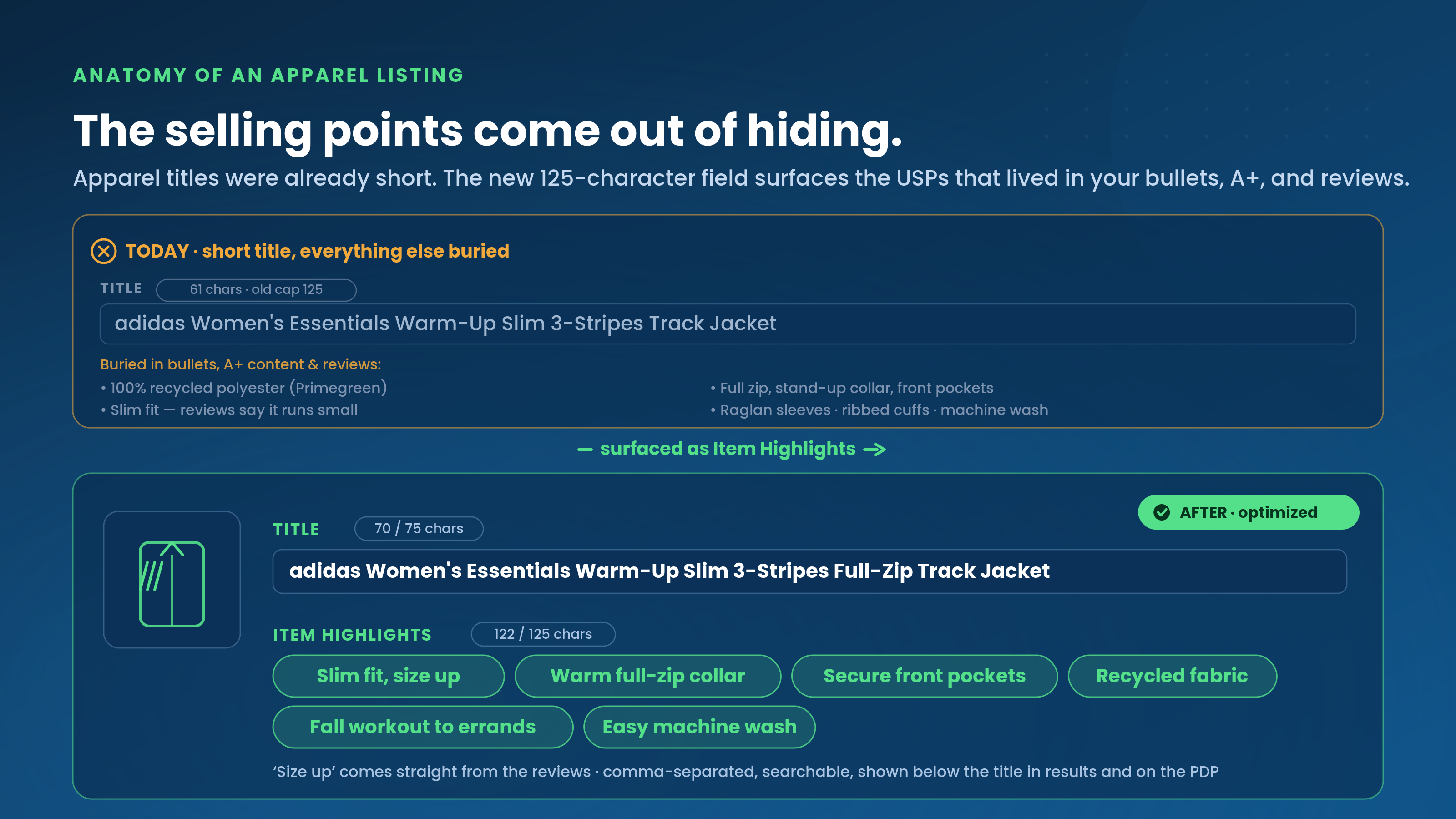
Take a real listing. adidas sells the Women's Essentials Warm-Up Slim 3-Stripes Track Jacket under a 61-character title, with almost everything that actually sells the jacket buried below the fold: the 100% recycled polyester, the slim cut that reviewers repeatedly say runs small, the full zip and stand-up collar, the front pockets, and the care details, all sitting in bullets, A+ content, and a review section where fit is the single most-discussed topic at 142 mentions. Under the new policy the title barely has to change, but the product finally wins a 125-character Item Highlights field to surface what was hidden. The title becomes "adidas Women's Essentials Warm-Up Slim 3-Stripes Full-Zip Track Jacket" (70 of 75 characters), and the highlights carry the reasons people actually buy, phrased as benefits rather than bare features: "Slim fit, size up, Warm full-zip collar, Secure front pockets, Recycled fabric, Fall workout to errands, Easy machine wash" (122 of 125 characters). The most valuable phrase in that list, "size up," comes straight from the reviews, and it now lives in a searchable field at the moment of comparison instead of being discovered after a return. The title stays clean, and the selling points once trapped in the description become discoverable, scannable, and built for conversion.
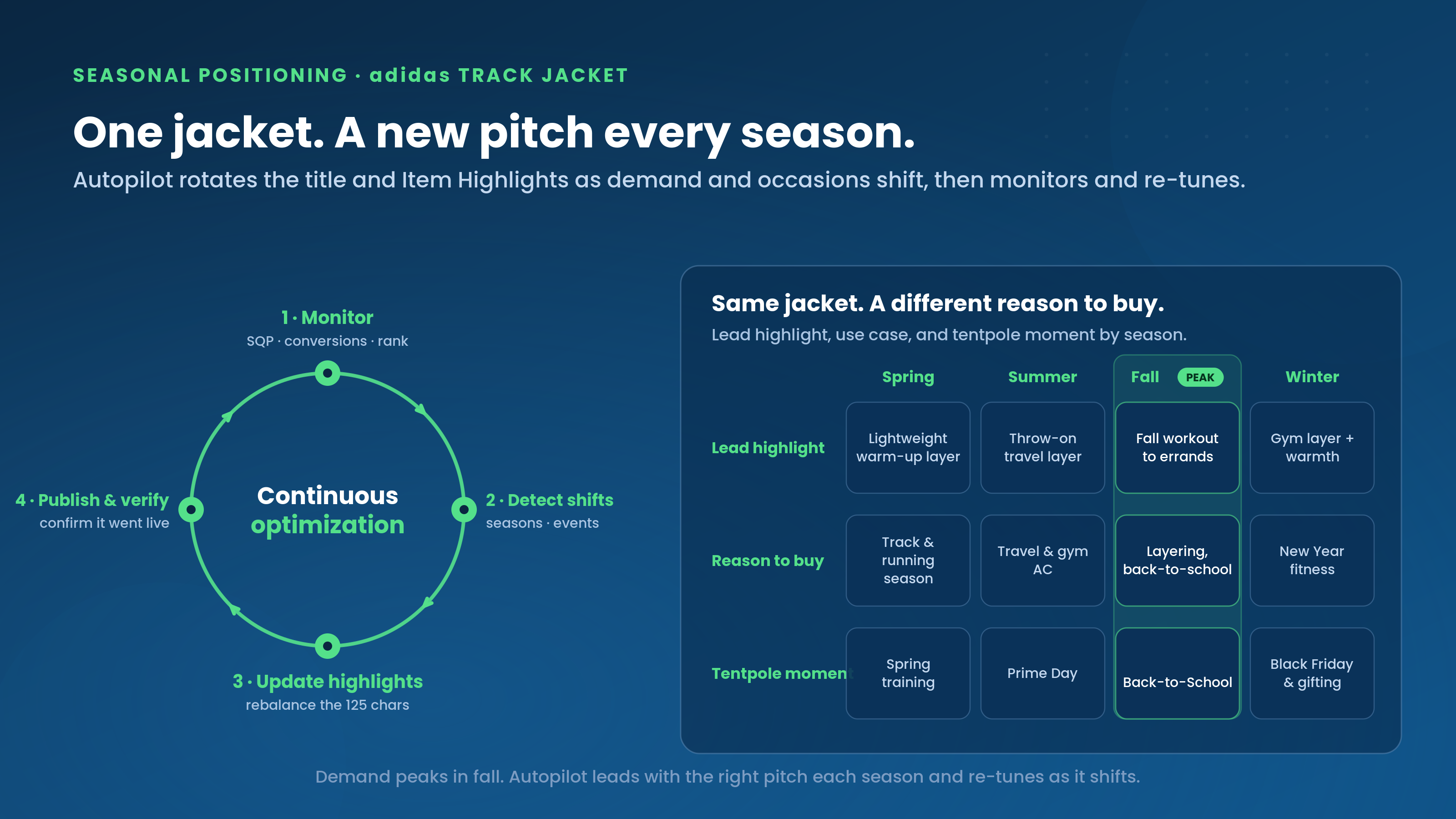
And the work does not stop at launch. A track jacket is not one pitch. In spring it is a lightweight warm-up layer for running season, in summer a throw-on travel layer, in fall (its peak) it leads with "fall workout to errands," and in winter it becomes a gym layer that sells on warmth and New Year fitness. Autopilot rotates the lead highlight, use case, and tentpole framing, from Back-to-School to Black Friday, as demand shifts, then monitors performance and re-tunes. The 125 characters never go stale, because the reason to buy never stops moving.
Autopilot does not generate Item Highlights by shortening your old title. It builds them from your product's Unique Selling Points, the key facts and outcomes that lead shoppers to choose your product.
Each USP starts from a substantiated fact about the product, such as a specific fabric weight, a stretch percentage, or a verified care instruction, and is turned into a shopper-facing selling point with a clear outcome, a target audience, and a differentiator against typical alternatives in the category. Autopilot extracts these from your listing content and customer reviews, and incorporates richer sources where available: spec sheets, product images, your direct-to-consumer site, and PIM data. It then ranks them by how strongly each should drive a purchase and how well the evidence supports it, leading with the best-evidenced selling points and weaving the rest through your content.
That ranking is what makes 125 characters count. With limited space, every phrase has to earn its place, and Autopilot spends the space on the highest-priority, best-supported USPs rather than guessing. Because USPs are generated automatically and refreshed as your listing and reviews change, your Item Highlights stay current instead of going stale.
This matters more in apparel than almost anywhere else, because the reason to buy moves with the calendar. Swimwear shifts from "vacation-ready" in spring to "resort season" in winter. A dress leads with "wedding guest" in spring and "holiday party" in December. Outerwear emphasizes "packable" in fall and "thermal-lined" at the depth of winter. Adult costumes have a single sharp peak. Autopilot rotates Item Highlights ahead of those demand windows on an ongoing basis, so the field always reflects why someone is buying right now.
For Autopilot customers, none of this is manual. We handle the transition for every ASIN under management. You see previews of your new titles and Item Highlights by June 26, with the chance to give feedback that shapes future iterations. We publish on a managed schedule between July 13 and July 24, ahead of Amazon's July 27 enforcement, so your listings transition on your terms rather than being swept into Amazon's automated rewrites. Then we monitor performance and keep tuning as the data comes in.
The result for apparel brands is the best version of this change: the new space claimed, filled with your strongest evidenced USPs, formatted to comply, and kept current season after season, with none of the catalog-wide manual work landing on your team.
Apparel brands spent years squeezed into a title that was never long enough. The July 27 policy quietly doubles your room and makes the new half searchable. The only question is whether your 125 characters get filled with your best selling points or with whatever Amazon's AI decides.
If you are on Autopilot, your previews are on the way and there is nothing else to do. If you are not, we will run a free audit of your apparel catalog and show you exactly what your titles and Item Highlights should say, where the fit, fabric, and occasion keywords are, and how much discovery space you are leaving on the table. No cost, no commitment.
Does the 75-character title cap apply to apparel? Yes. Starting July 27, 2026, titles in apparel categories must be 75 characters or less including spaces, the same as other categories. The difference is that apparel titles were already capped at 125 characters, so the trim is smaller, and apparel gains a 125-character Item Highlights field on top.
So do apparel brands actually gain space? Yes. You move from 125 characters of title-only optimization space to 75 characters of title plus 125 characters of searchable Item Highlights, which is 200 characters in total and a net gain of 75. The new field is searchable and appears beneath the title in search results and on the product detail page.
Which apparel categories are affected? The change spans Apparel, Shirts, Pants, Shorts, Skirts, Dresses, Sweaters, Blazers, Suits, Outerwear, Swimwear, Sleepwear, Underwear, Bras, Socks and Hosiery, Adult Costumes, and Accessories, among others.
What should go in apparel Item Highlights? Comma-separated phrases, not full sentences, covering the attributes that drive an apparel purchase: fit, fabric, stretch, rise, length, coverage, care, and occasion. For example: "Squat-proof, High-waisted, 4-way stretch, Quick-dry, Hidden pocket."
How does Autopilot decide what to include? It builds Item Highlights from your ranked Unique Selling Points, the substantiated facts and outcomes drawn from your listing, reviews, spec sheets, images, DTC site, and PIM data. It leads with the highest-priority, best-evidenced selling points, formats them to comply, and refreshes them as your listings, reviews, and seasons change.
Autopilot is an Amazon listing optimization and AI discovery service. Since 2023 it has published more than 2 million listing updates for 450+ brands.