Before AI Assistant Sales Comes AI Attention
The rise of AI discovery in all of our personal lives is changing the nature of how brands sell online, and opening a new, Third Shelf:
Organic search was the first channel - let’s call it the First Shelf, regardless of whether the brand was found on Amazon or DTC. Paid search was the second. The AI shelf is the Third Shelf: the short list of products an AI personal assistant names when a shopper asks what to buy. “ChatGPT, what’s the right thing to feed little Susie?”
What’s the right way to make sure your brand lands in the answer here? The starting point of any optimization, and AI assistant sales, is making sure your brand’s content is read and well understood by AI.
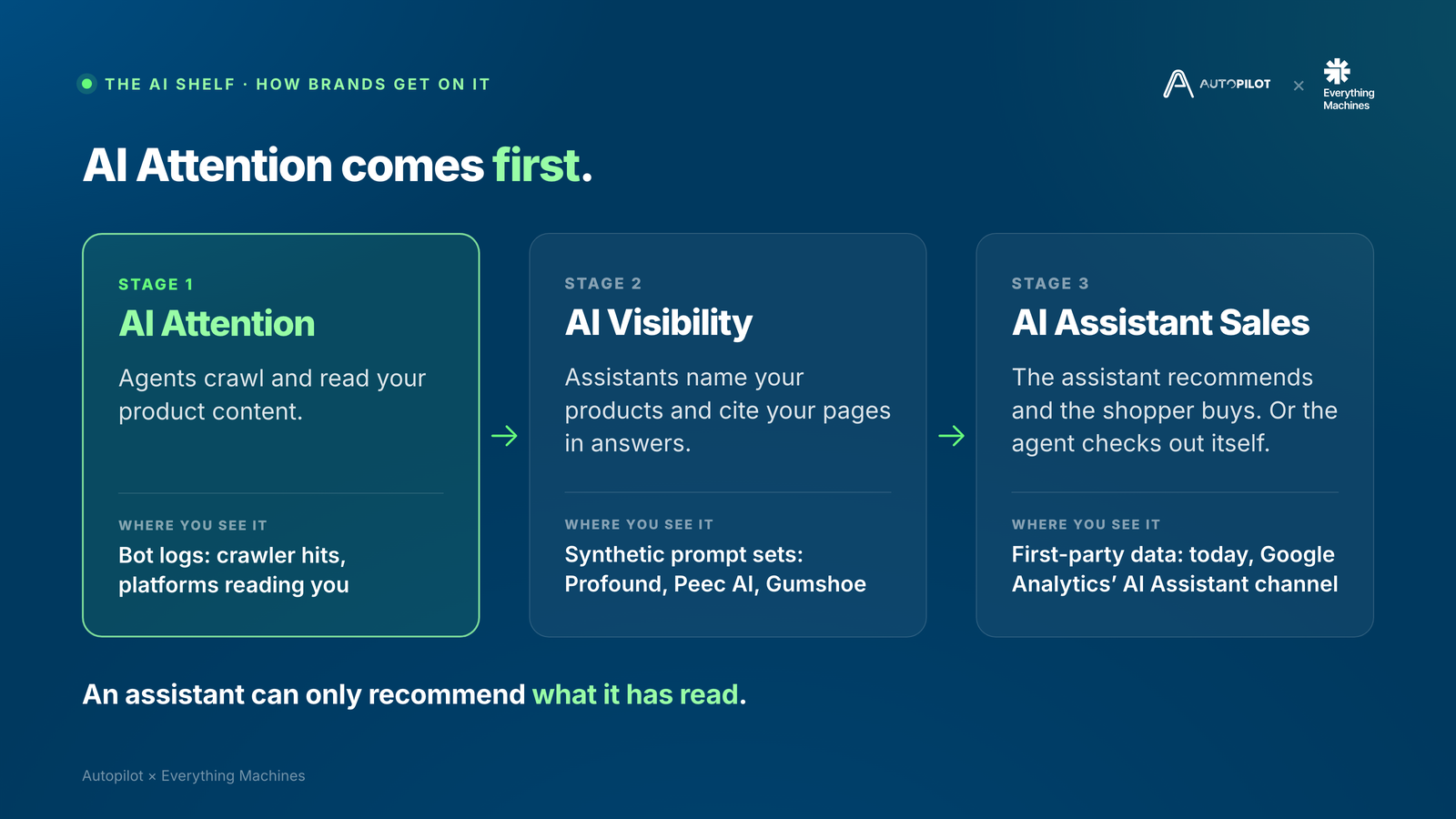
AI attention doesn’t start on Reddit. In current AI models, 80%+ of data retrieval goes to the core domain first. Reddit is very strong within the remaining 20% (and across all brands that explains its popularity), but it’s not a suitable starting point for a brand's AI discovery journey. Their own domain is.
The path to the AI shelf has three steps, and each one is measured in a different place.
No attention means there’s nothing to cite, nothing to recommend, nobody to refer. We’ve found a repeatable 3-step way to get that attention and more.
An Agentsite is an extremely machine-readable copy of your catalog & content, linked from your own domain in the format agents read. It complements your website but does does not replace it. Agentsites are developed & hosted by our partner Everything Machines because while: Websites are great for people. Agentsites are designed for agents.
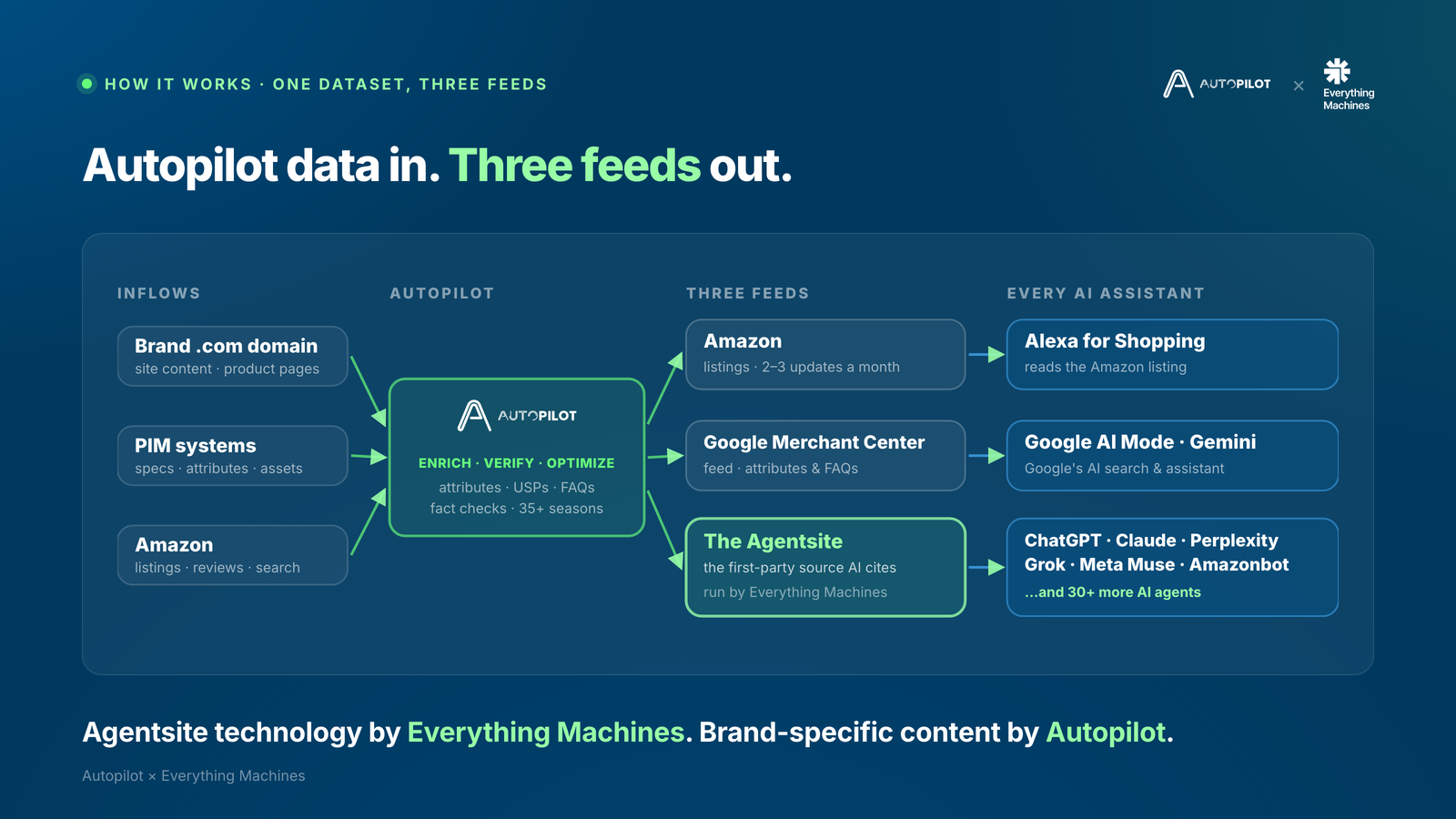
Everything Machines builds and runs the Agentsite. Autopilot then pushes in a selection of highly effective brand-specific content. Autopilot pulls product data from three sources: your .com, your Product Information Management systems (like Salsify or Syndigo) and marketplace data from channels such as Amazon. It enriches and verifies that data.
Agents learn about the brand, its products, personas, trust signals, virality, availability, distribution, and where shoppers can buy, all grounded in facts. The approach overcomes the limitations of Shopify’s Universal Commerce Protocol (which is a great starting point), and increases the trust and authority AI bots build in the brand’s core domain, and its information.
Then one dataset goes out as three feeds: your Amazon listings, your Google Merchant Center feed and your Agentsite. Each feed serves a different set of assistants. The Agentsite is the one that ChatGPT, Claude, Meta and the rest can crawl directly & frequently.
Alexa for Shopping (previously known as Rufus)has laid the foundation for the shopping intent graph around personas, use cases, uses & many more dimensions that matter when it comes to making products understood in AI search.
Example: a Toys & Games brand's product page says "heatable." Its Amazon reviews show shoppers also freeze the product for cold therapy. The Agentsite carries both.
Point your domain and your llms.txt at the Agentsite. A 5-min adjustment ensures both citations flowing to the core brand domain, and ongoing AI assistant discoverability.
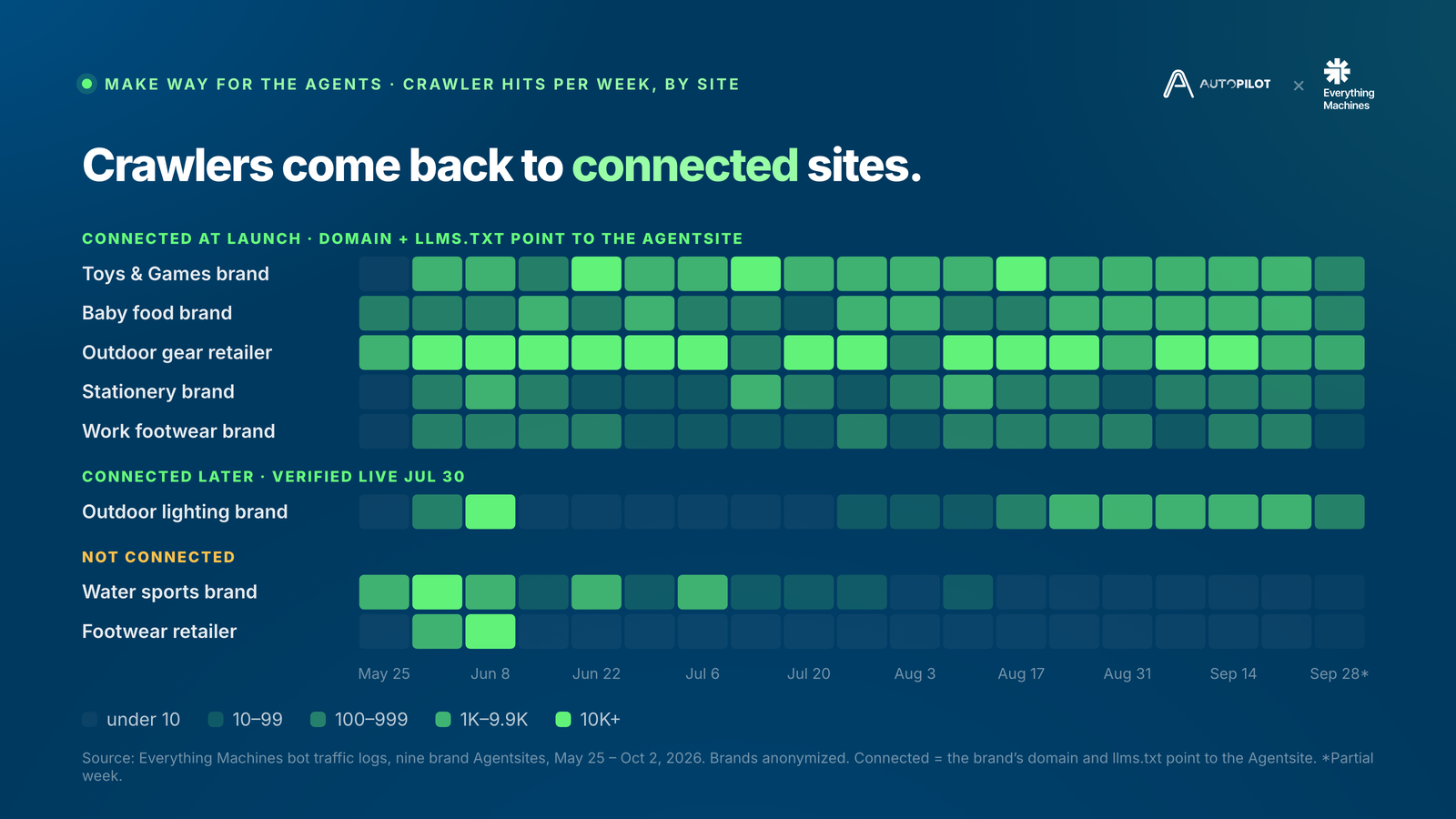
Each row is one brand's Agentsite. Each square is one week. Brighter green means more crawler hits. The top five rows are sites that were connected at launch: they stay green all the way to October. The bottom two were never connected: crawlers swept them once in June, then stopped. The connected sites drew 314,000 crawler hits in the twelve weeks from mid-July. The two unconnected ones drew 153.
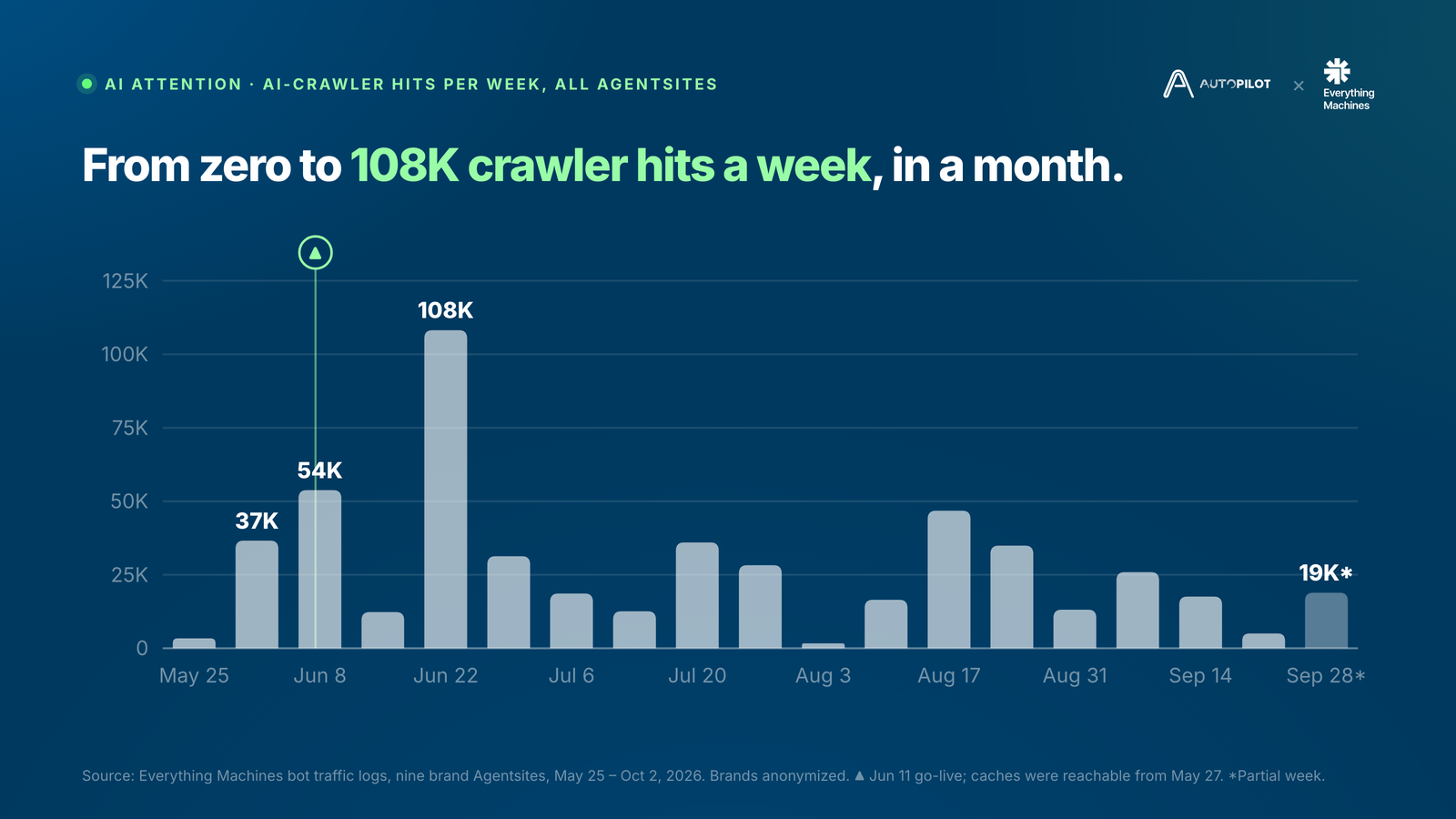
Each bar is one week of AI-crawler hits across all the Agentsites. They went live in early June, with no promotion and no link building. Every site was crawled by OpenAI or Meta within a week of coming online. By the week of June 22 the crawl peaked at 108,000 hits. It has continued every week since: 521,000 hits in 18 weeks.
We started of with the three big labs, but who’s crawling now is an indication to where broader AI personal assistant development is going:
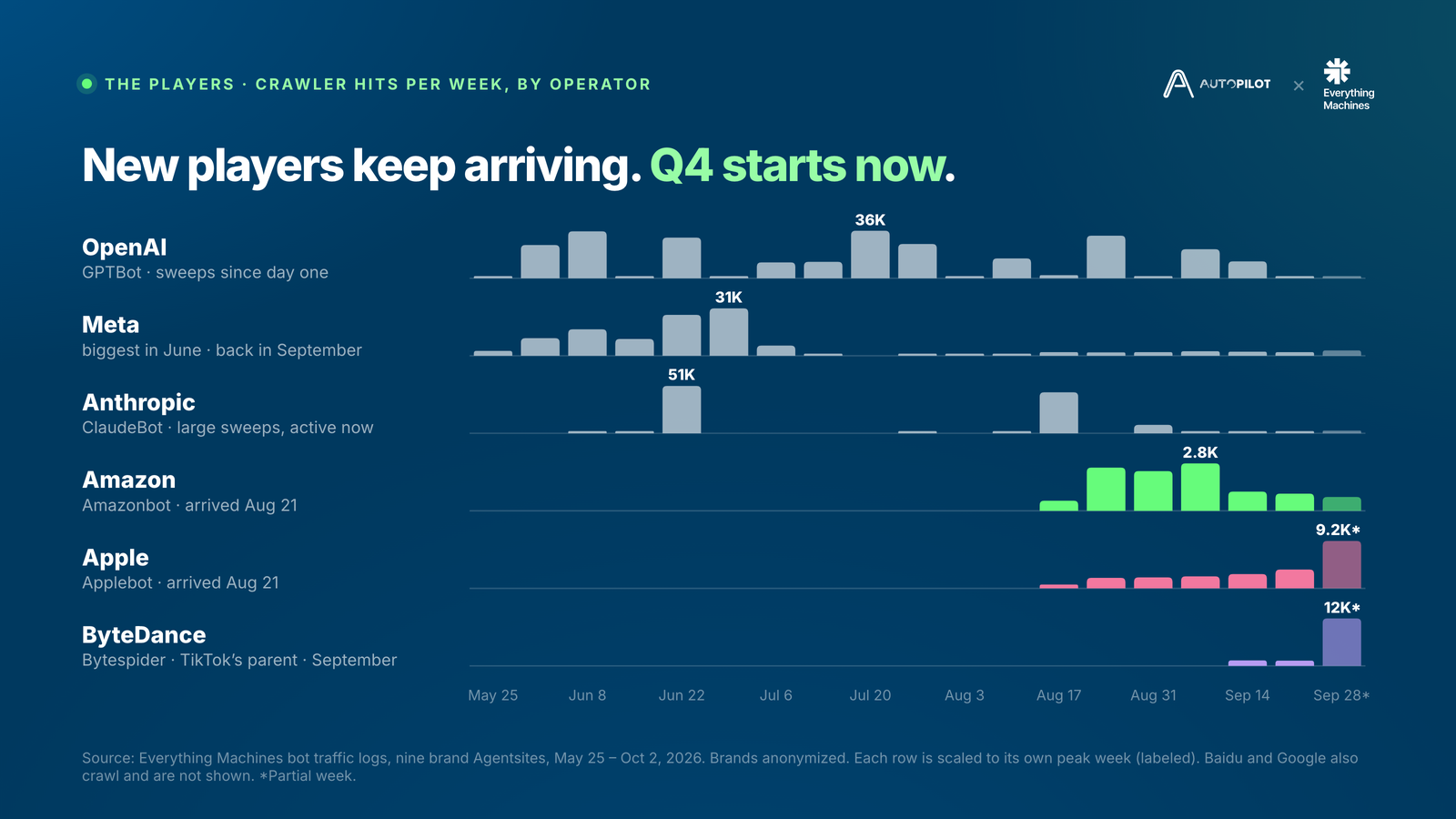
Each row is one company's crawler, week by week, scaled to its own peak.
In the most recent week, Apple and ByteDance together made 21,000 hits. That is 62% of all crawler activity.
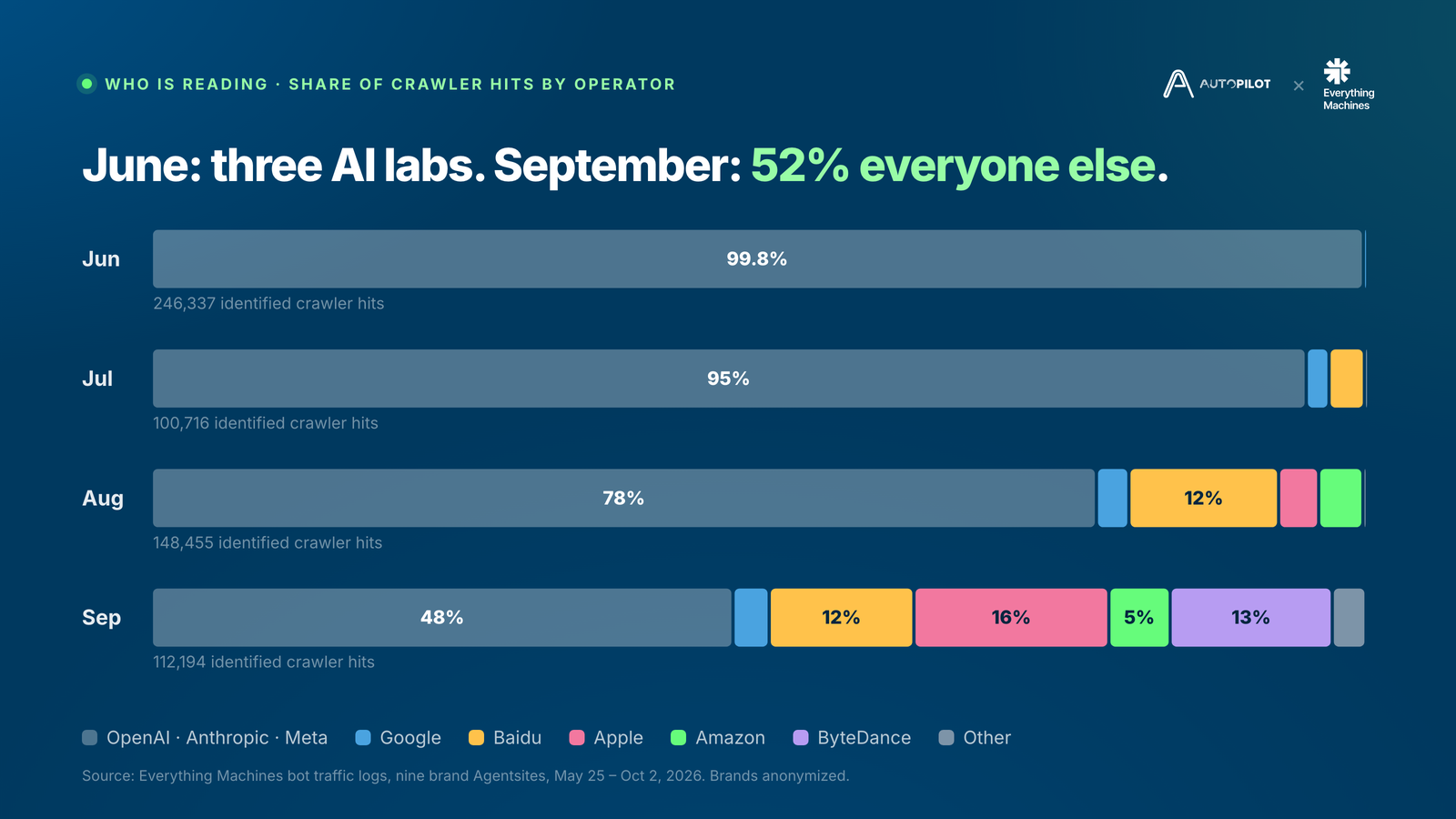
Each bar is one month, split by who did the crawling. The grey segment is the three AI labs: OpenAI, Anthropic and Meta. In June they were 99.8% of the crawl. In September they were 48%. The colored segments are the newer players: Apple, ByteDance, Baidu, Amazon and Google.
AI-assisted commerce is entering its biggest quarter. The activity and the number of players are both heating up.
This is a small sample: nine brands. The pattern was the same on every connected site.
These are early signals from a limited set of brands, but the flow was true each time: read & comprehended, cited, bought. And the buyer is no longer always a person. Agents like Meta's Muse can now complete a checkout on a shopper's behalf, which makes being read the entry ticket.
The companies behind Siri, Alexa, TikTok and Meta's Muse are now reading brand sites. Give them something to read.
Want to see where your brand stands on the AI shelf? Get your brand evaluation.
Autopilot is an Amazon listing optimization and AI discovery service. Since 2023 it has published more than 2 million listing updates for 450+ brands.